
Weekly Shonen Jump
Contents
Weekly Shonen Jump is a weekly manga magazine published in Japan by Shueisha. It is responsible for serializing the One Piece manga—among many others—in its original, single-chapter form.
Since its inception in 1968, Weekly Shonen Jump has sold over 7.5 billion copies (with weekly circulation exceeding 6.5 million at its height in the 1990s), consistently ranking as the world's most popular comic-book anthology. It remains a particularly important outlet for new manga creators, many of whom—Eiichiro Oda included—developed their skills as assistants for its established creators.
Format
As its title suggests, Weekly Shonen Jump primarily targets the shonen demographic of teenage boys, and trends toward series with majority-male casts and spectacle-heavy plots (though recent polls have indicated several of its series, One Piece included, may actually have majority-female readerships). In addition to One Piece, it has launched some of Japan's most iconic shonen properties, including KochiKame, Dragon Ball, JoJo's Bizarre Adventure, Rurouni Kenshin, Yu-Gi-Oh!, Naruto, Bleach, and My Hero Academia.
(In 2016, with the conclusion of the long-running KochiKame (and the migration of JoJo's Bizarre Adventure to an offshoot magazine some years before), One Piece became Jump ' s oldest active series. The closest contender, Hunter x Hunter, began in 1998 and publishes new material on an inconsistent basis).
The typical issue of Jump is between 450 and 500 pages long, containing around twenty different installments of manga interspersed with editorial features, celebrity interviews, advertisements, and other promotional materials (often for anime or video games licensed off one of its properties). Its print quality is frequently noted to be "yellowed" or otherwise substandard, as it primarily uses recycled paper.
Every issue prints the first few pages of several different series in color; for One Piece, this usually manifests in the series' famed color spreads.
Organization
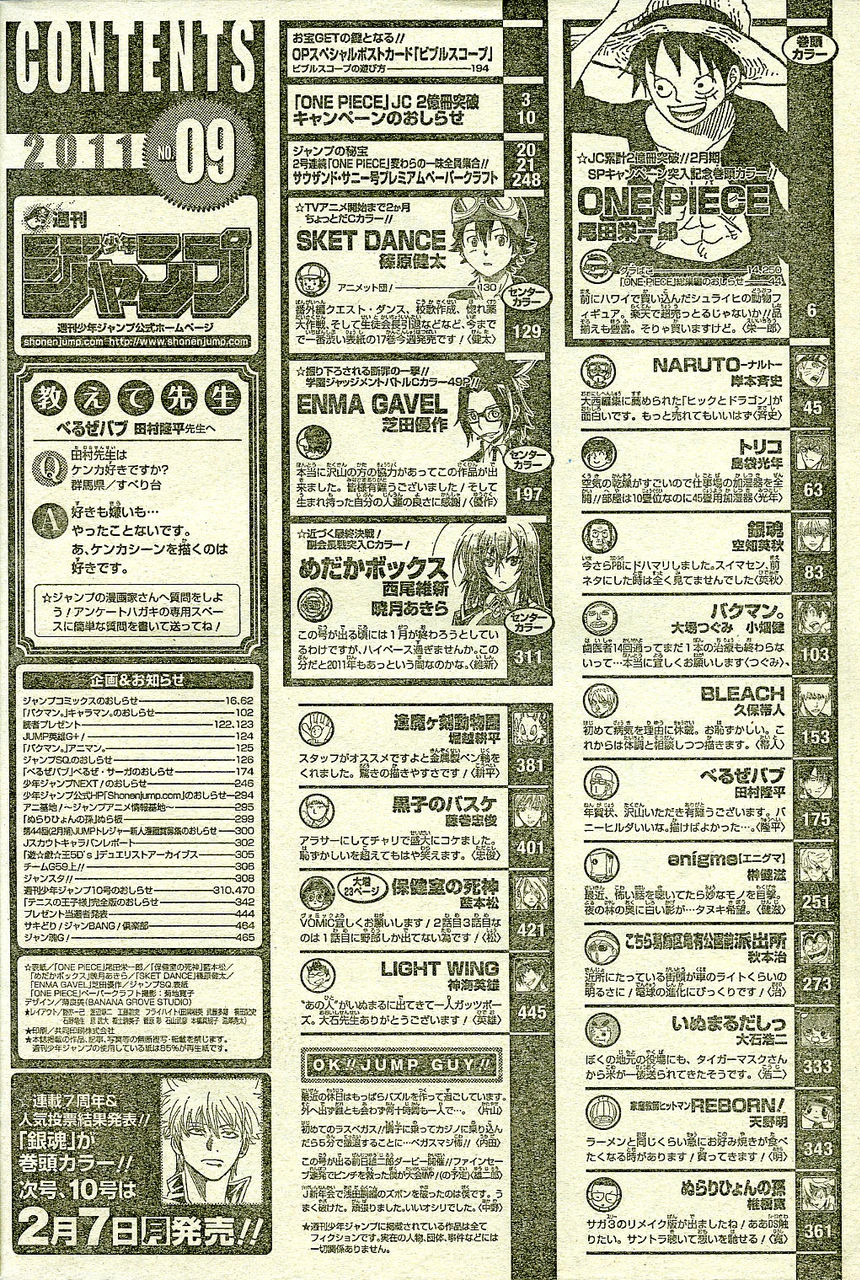
Jump famously reorganizes the order of its contents every week, following a combination of editor initiative and reader response. These are (imperfectly) reflected by each issue's table of contents: When charting series popularities, fans typically focus on the black-and-white features' ordering, dismissing the color features' as purely editorial decisions. The exact accuracy of this metric is debatable; while most color features are promotional in nature (indeed, Jump traditionally features the first chapter of any new series as a Lead Color), and series that consistently rank last as black-and-white features are often ended within a few months, there have been notable exceptions to both patterns.
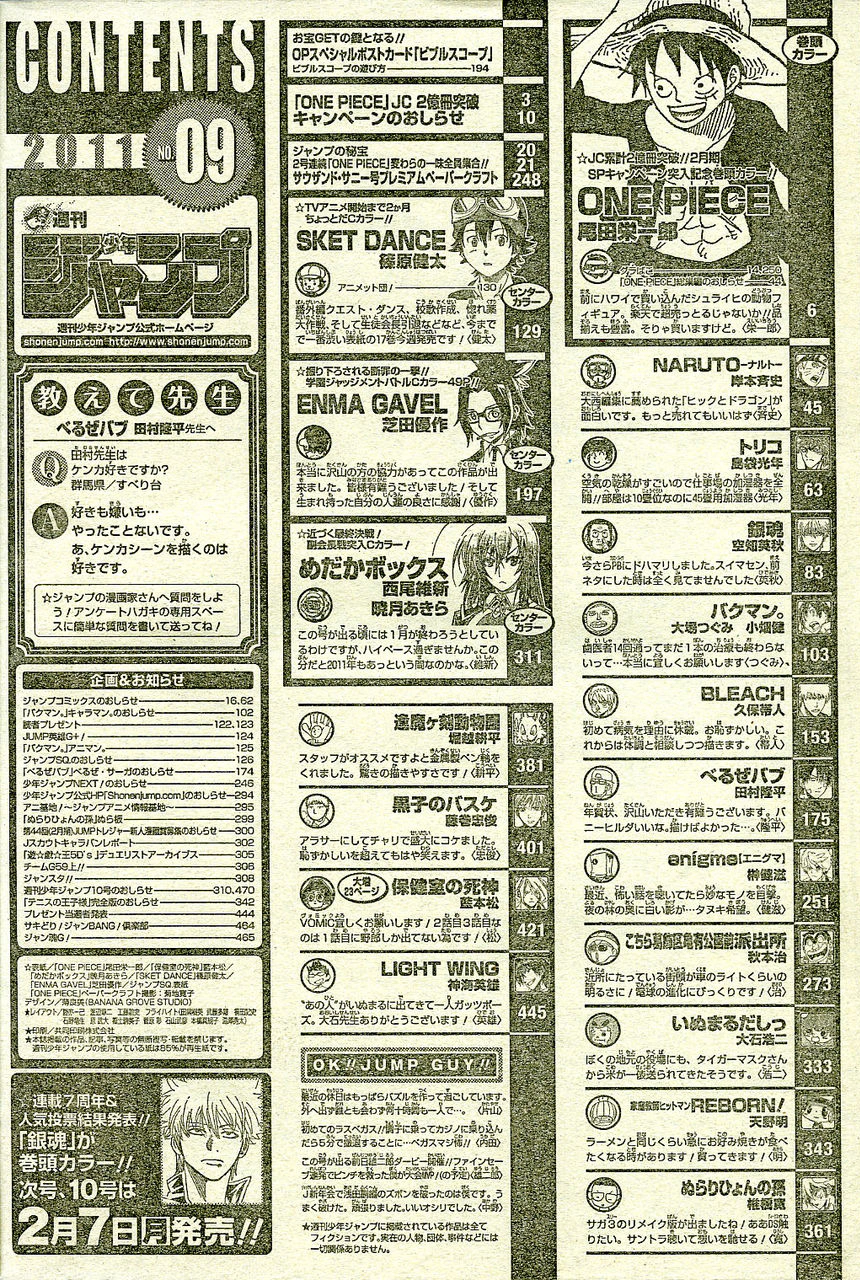
In any case, One Piece is almost always placed among the first four features of any given issue, colored or otherwise. It has maintained this dominance since at least the mid-2000s.
• One series will be the Lead Color feature, printed in color for its first few pages and placed ahead of all others. The issue's cover-art will usually—but not always—be focused on this series.
• Several series will be Center Color features, and also printed in color for their first few pages. These may be placed anywhere after the Lead Color feature; in some cases, they may even be the last feature.
• The remaining features will be printed in standard black-and-white.
Schedule and Numbering
Jump typically releases new issues on Monday of each week, with semi-regular shifts to other days (most often preceding Saturdays) when the printing schedule is affected by "minor" holidays or other incidents. However, there are four "major" holidays that skip release entirely on adjacent weeks:
Issues are indexed by year, each issue's cover being billed with a number (which resets with every new year) and a specific date; the issue that published the first chapter of One Piece, for instance, is billed as 1997's Issue 34 - August 4. Note that these, much like the cover dates of American comics, tend to be weeks or even months behind each issue's actual release date, with the "first" issue in any given year usually released in late November of the preceding year.
Any issues released immediately before major-holiday weeks are billed as "double" issues (e.g. Issue 4-5). This is purely to help the indexing process, and does not in any way promise extra material for the issue.
• New Year's Day, usually corresponding to the first or second week in January
• Golden Week, usually corresponding to the last week in April or first week in May
• Obon, usually corresponding to the second or third week in August
• Christmas, usually corresponding to the third or fourth week in December
Digital Release
Notwithstanding a few special releases in 2011 and 2013, Shueisha began publishing fully digital editions of Jump with 2014's Issue 25 - June 2. These are released simultaneously with their print counterparts, and feature largely identical content; distribution occurs mainly through Shueisha's Jump Book Store and Jump+ platforms, along with a number of third-party sellers.
Publication of One Piece
As mentioned, Jump began serializing the One Piece manga with 1997 Issue 34. Since then, the series has maintained steady weekly publication, running a chapter in a majority of the issues published in any given year. Eiichiro Oda started to take regular breaks around 10 years into the serialization, eventually reaching an average of roughly 10 breaks per year from 2013 on. These breaks are generally spread out throughout the year and almost never skip more than one issue at a time. There are currently four notable exceptions:
The following table presents the full publication history of One Piece in Jump. Note that all years are based on Jump ' s own indexing, which can differ from the actual year of publication (see Schedule and Numbering above).
One Piece in Weekly Shonen Jump - 1997 1998 1999 2000 2001 2002 2003 2004 2005 2006 2007 2008 2009 2010 2011 2012 2013 2014 2015 2016 2017 2018 2019 2020 2021 2022 2023 2024 2025 2026 - 1 1167 - 2 1168 - 3 - 4 1169 - 5 1036 - 6 1170 - 7 1037 - 8 1171 - 9 - 10 1172 - 11 1173 - 12 1174 - 13 - 14 1175 - 15 1176 - 16 - 17 1177 - 18 1178 - 19 1179 - 20 - 21 1180 - 22 1181 - 23 1082 - 24 1182 - 25 - 26 1183 - 27 1184 - 28 - 29 1185 - 30 - 31 1186 - 32 1187 - 33 1188 - 34 - 35 1189 - 36 - 37 1190 - 38 1157 - 39 1191 - 40 - 41 1192 - 42 - 43 - 44 - 45 - 46 - 47 - 48 - 49 - 50 - 51 - 52 - 53
A full month of vacation—skipping four consecutive issues—followed his completing the first half of the series in 2010.
A second month-long hiatus—skipping four consecutive issues—at the conclusion of the Wano Country Arc in 2022.
A third month-long hiatus—skipping four consecutive issues—in the summer of 2023 due to Oda undergoing eye surgery for his astigmatism.
A hiatus skipping three consecutive issues in the spring of 2024 for "scheduled maintenance" of Oda's body as well as material gathering and planning.
Cover Gallery
As a preeminent Jump property, One Piece has been directly featured on a number of its covers. These cover illustrations—almost always supplied by Eiichiro Oda—are frequently reused to illustrate the title pages (or back covers) of subsequent tankobon, and always reproduced in the Color Walk collections.
Lead Covers
Jump typically makes One Piece its Lead Color feature between six and eleven times per year. These issues also reproduce a portion of the cover-art—usually cropped to focus on Luffy's face—on the spine.
-bgcolor="#abcdef" 1997 1998 1999 2000 2001 2002 -valign="top" Issue 34 Issue 46 Issue 50 Issue 17 Issue 26 Issue 29 Issue 47 Issue 50 Issue 15 Issue 24 Issue 35 Issue 37-38 Issue 45 Issue 49 Issue 16 Issue 36-37 Issue 42 Issue 16 Issue 33 Issue 41 Issue 44 Issue 15 Issue 37-38 Issue 50 -bgcolor="#abcdef" -valign="top" Issue 13 Issue 25 Issue 32 Issue 47 Issue 14 Issue 25 Issue 43 Issue 14 Issue 39 Issue 43 Issue 48 Issue 52 Issue 13 Issue 17 Issue 24 Issue 29 Issue 47 Issue 13 Issue 17 Issue 26 Issue 34 Issue 43 Issue 13 Issue 29 Issue 44 Issue 49 -bgcolor="#abcdef" -valign="top" Issue 12 Issue 18 Issue 30 Issue 53 Issue 1 Issue 2 Issue 5-6 Issue 16 Issue 28 Issue 44 Issue 50 Issue 9 Issue 25 Issue 28 Issue 45 Issue 16 Issue 47 Issue 2 Issue 3 Issue 4-5 Issue 13 Issue 18 Issue 28 Issue 46 Issue 49 Issue 30 Issue 47 -bgcolor="#abcdef" -valign="top" Issue 10 Issue 15 Issue 30 Issue 45 Issue 1 Issue 13 Issue 18 Issue 29 Issue 33 Issue 34 Issue 47 Issue 1 Issue 6 Issue 15 Issue 33 Issue 42 Issue 52 Issue 18 Issue 23 Issue 34 Issue 40 Issue 47 Issue 17 Issue 28 Issue 34 Issue 35 Issue 44 Issue 13 Issue 19 Issue 27 Issue 33-34 Issue 46 -bgcolor="#abcdef" -valign="top" Issue 14 Issue 18 Issue 33-34 Issue 40 Issue 45 Issue 49 Issue 10 Issue 18 Issue 29 Issue 35 Issue 42 Issue 49 Issue 13 Issue 25 Issue 28 Issue 34 Issue 40 Issue 45 Issue 2 Issue 13 Issue 17 Issue 34 Issue 45 Issue 17 Issue 19 Issue 26 Issue 34 Issue 44 Issue 52 Issue 15 Issue 26 Issue 33 Issue 39
1997-2002
2003-2008
2009-2014
2015-2020
2021-2026
Ensemble Covers
Covers that feature One Piece characters with other heroes from the magazine.
- bgcolor="#abcdef" 1997 1998 1999 2000 2001 2002 - valign="top" Issue 4-5 Issue 6 Issue 22-23 Issue 4-5 Issue 6 Issue 46 Issue 3-4 Issue 5-6 Issue 21-22 Issue 22-23 Issue 3-4 Issue 5-6 Issue 19 Issue 21-22 Issue 4-5 Issue 6-7 Issue 22-23 - bgcolor="#abcdef" - valign="top" Issue 5 Issue 6-7 Issue 4-5 Issue 6-7 Issue 22-23 Issue 3-4 Issue 5-6 Issue 13 Issue 21-22 Issue 36-37 Issue 4-5 Issue 6-7 Issue 21-22 Issue 36-37 Issue 42 Issue 4-5 Issue 6-7 Issue 22-23 Issue 36-37 Issue 4-5 Issue 6-7 Issue 18 Issue 34 Issue 37-38 - bgcolor="#abcdef" - valign="top" Issue 4-5 Issue 6-7 Issue 22-23 Issue 37-38 Issue 48 Issue 21-22 Issue 36-37 Issue 3-4 Issue 5-6 Issue 16 Issue 20-21 Issue 35-36 Issue 3-4 Issue 5-6 Issue 21-22 Issue 36-37 Issue 6-7 Issue 22-23 Issue 33 Issue 37-38 Issue 4-5 Issue 6-7 Issue 16 Issue 22-23 Issue 37-38 - bgcolor="#abcdef" - valign="top" Issue 4-5 Issue 6-7 Issue 19 Issue 22-23 Issue 37-38 Issue 48 Issue 3-4 Issue 5-6 Issue 21-22 Issue 36-37 Issue 2-3 Issue 4-5 Issue 21-22 Issue 34 Issue 36-37 Issue 2-3 Issue 4-5 Issue 6 Issue 21-22 Issue 33 Issue 36-37 Issue 4-5 Issue 6-7 Issue 22-23 Issue 36-37 Issue 4-5 Issue 6-7 Issue 23 Issue 31 Issue 36-37 - bgcolor="#abcdef" - valign="top" Issue 3-4 Issue 5-6 Issue 21-22 Issue 36-37 Issue 3-4 Issue 5-6 Issue 21-22 Issue 34 Issue 36-37 Issue 4-5 Issue 6-7 Issue 21-22 Issue 33 Issue 36-37 Issue 4-5 Issue 6-7 Issue 22-23 Issue 36-37 Issue 4-5 Issue 6-7 Issue 22-23 Issue 36-37 Issue 4-5 Issue 6-7 Issue 37-38
1998-2002
2003-2008
2009-2014
2015-2020
2021-2026
Joint Covers
There have been four instances of a One Piece Jump illustration being split into multiple covers.
Shonen Jump 2009 Issue 53 and 2010 Issues 1 & 2 celebrate the premiere of One Piece Film: Strong World. The cover features the Straw Hat Pirates in their Strong World outfits as well as various animals from the film. This is the only instance of a triple joint cover to date.
Shonen Jump 2017 Issues 2-3 & 4-5 celebrate the anniversary year in which One Piece achieves 20 years of serialization. The cover features Luffy in the middle forming the number "20" with his fingers. He is surrounded by protagonists from other Shonen Jump series dressed as One Piece characters.
Shonen Jump 2019 Issues 34 & 35 celebrate One Piece achieving 22 years old serialization, the movie Stampede and the second act of the Wano Country Arc. The cover features Luffy in middle holding Nidai Kitetsu, with Zoro, Sanji, Nami and Robin on the left side, and Law, Sabo, Hancock and Lucci on the left. The Straw Hats are dressed in their Wano Arc outfits, while the other characters wear unique Wano-themed outfits.
Shonen Jump 2021 Issues 3-4 & 5-6 in 2021 celebrate Chapter 1000. The cover features Luffy with a crown that says "1000" on his head. He is surrounded by protagonists from other Shonen Jump series together with various One Piece characters drawn in the style of the protagonists' respective authors. The list of characters is the following:

On the left:
Krieg with Izuku Midoriya from My Hero Academia by Kōhei Horikoshi.
Portgas D. Ace with Senku Ishigami from Dr. Stone by Boichi.
Bellamy with Mash Burnedead from Mashle: Magic and Muscles by Hajime Kōmoto.
Boa Hancock with Nariyuki Yuiga from We Never Learn by Taishi Tsutsui.
Gecko Moria with Tachikaze Saga from Agravity Boys by Atsushi Nakamura.
Tashigi with Boyle Samejima from Hard-Boiled Cop and Dolphin by Ryuhei Tamura.
Gaimon with Tonkachi from Build King by Mitsutoshi Shimabukuro.
Tony Tony Chopper with Taiyo Asano from Mission: Yozakura Family by Hitsuji Gondaira.
Shinobu with Kotaro Ietani from High School Family: Kokosei Kazoku by Ryo Nakama.
On the right:
Shirahoshi with Asta from Black Clover by Yūki Tabata.
Arlong with Yuji Itadori from Jujutsu Kaisen by Gege Akutami.
Smoker with Andy from Undead Unluck by Yoshifumi Tozuka.
Sugar with Matsuri Kazamaki from Ayakashi Triangle by Kentaro Yabuki.
Lapahn with Magu Menueku and Ruru Miayanagi from Magu-chan: God of Destruction by Kei Kamiki.
Sanji with Roboco from Me & Roboco by Shuhei Miyazaki.
Benn Beckman with Sakamoto from SAKAMOTO DAYS by Suzuki.
Nico Robin with Ko Hizuki from Our Blood Oath by Kakazu.
Heracles with Moriking from Moriking by Tomohiro Hasegawa.
Eustass Kid with Iori Katanagi from Phantom Seer by Kento Matsuura.
Weekly Shonen Sunday Collaboration
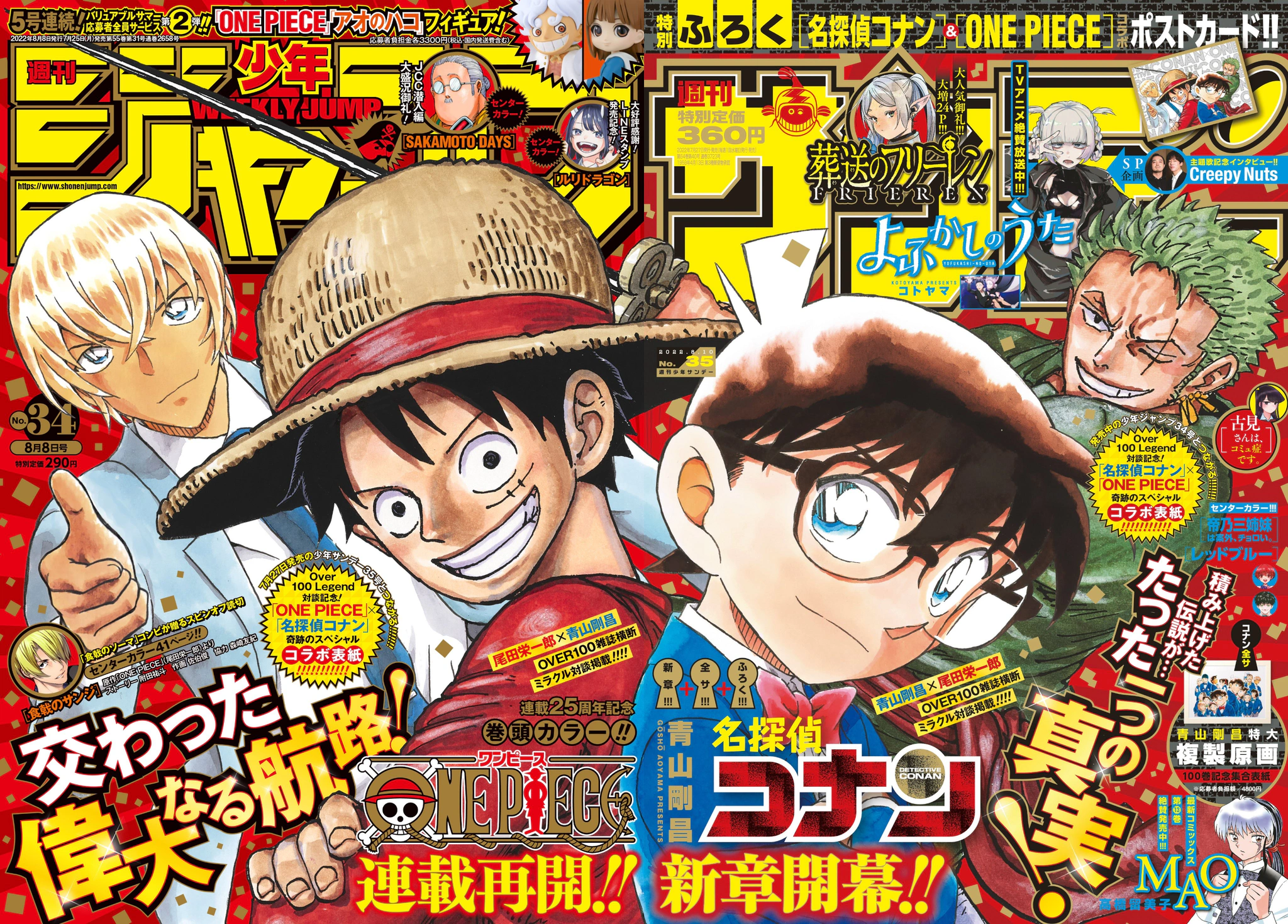
The cover of Shonen Jump 2022 Issue 34 forms a joint cover together with Weekly Shōnen Sunday 2022 Issue 35. Shonen Sunday is a weekly shōnen manga magazine published by the publishing company Shogakukan. The joint cover was part of a collaboration between Eiichiro Oda and Gosho Aoyama, the author of Detective Conan (Case Closed). The illustration features Monkey D. Luffy and Roronoa Zoro with Detective Conan characters Conan Edogawa and Rei Furuya.
Related Titles
Due to its popularity, Weekly Jump has accrued many offshoot titles with different formats and target demographics. Most of these are irrelevant to One Piece, but several were responsible for publishing Eiichiro Oda's pre-One Piece one-shots, most prominently the later-canonized Monsters.