
Bounty
Contents
A bounty is a reward, usually monetary, promised for the accomplishment of a certain task. Most instances of the term in One Piece refer to rewards for capturing or killing a specifically "wanted" person, also known as a bounty head.
Currently, the world's predominant bounty system is managed by the Marines to bring pirates and other criminals to justice. However, powerful pirates are also known to issue bounties, with the Cross Guild being especially notorious for maintaining a comprehensive bounty system on the Marines themselves. Bounty hunters make their primary living by apprehending wanted people and claiming the reward.
Most of the world's bounties are issued by the World Government—via the Marines—with the intent of alerting the public about dangerous criminals, as well as encouraging civilians to help capture them. Each bounty amount is calculated by a dedicated department within Marine Headquarters (currently headed by Commodore Brannew), based on the perceived threat level of a given criminal; the lowest known bounty ever issued was 50, for the capture of Tony Tony Chopper, who was mistaken for being the Straw Hat Pirates' pet. The highest known bounties, belonging to the great pirates who ruled over the New World, have been more than 4,000,000,000. The highest-known bounty in history belonged to Gol D. Roger, the Pirate King, with bounty hunters being promised 5,564,800,000 for his capture.
The standard bounty is issued with a "Dead or Alive" clause, signifying that the criminal no longer has protection from the law and therefore can be killed without repercussion. This makes both live captures and confirmed kills eligible for the reward. However, according to Baroque Works, authorities may detract up to 30% of a bounty if given a dead criminal, as they favor live captures for prison sentences and/or formal executions. Alternatively, an "Only Alive" clause has been knowingly (albeit temporarily) approved for at least one individual, due to political influence from a significant kingdom invested in his survival.
Criminal organizations, such as pirate crews, typically only have bounties on their leaders or figureheads (eg. captains). However, larger organizations, in particular Four Emperors crews and more prominent pirate crews, will have bounties on some or all of their subordinates.
Bounties are not known to carry any statute of limitations; even criminals that have remained inactive for over a century, such as Dorry and Brogy, are viable as bounty heads as long as they have not been confirmed deceased.
Certain circumstances may result in a bounty being frozen, rendering it temporarily inactive and shielding that person from judicial persecution. Notable examples include membership in the Seven Warlords of the Sea (which extends to all explicit subordinates), as well as slavery under the World Nobles. However, if these circumstances are retracted for any reason, the bounty will automatically be reinstated—possibly even increasing—and re-legitimize arrest. It is unknown if criminals who are legitimately accepted into the Marines (e.g., Jango) have their bounties permanently removed.
It also remains unknown how or where exactly bounties are claimed, though the system is apparently reliable enough to support multiple industries of professional bounty hunters. Bounty collection is, predictably, barred to pirates and other criminals, though exceptions can be made for petty miscreants such as the Franky Family.
Issuing and Increasing
A bounty reflects both the threat and power of an individual as perceived by the World Government. Engaging in activities deemed criminal by the World Government or associating with groups that engage in them is enough to warrant significant bounties, even if the criminal is not personally powerful. In particular, any direct opposition to the World Government, no matter the reason, is treated as a serious offense, and bounties are issued accordingly. Nico Robin, for example, has knowledge deemed illegal by the World Government and was issued a bounty of 79,000,000 at the age of eight, despite not personally participating in any immoral activity.
A bounty also reflects the current state of the economy. When the value of currency changes, so does the standard worth of a criminals capture. For example, Dorry and Brogy were both worth 100,000,000 when their crew was active a century ago, but they both jumped to 1,800,000,000 following the Egghead Incident after a hundred years of inflation.
Simply associating with a notable criminal figure can be enough to get a bounty; for instance, following the Dressrosa battle, several of Monkey D. Luffy's crew members and allies all got flat increases of 50,000,000 regardless of their role or presence during the incident. Pets can also receive bounties, though these bounties are often substantially smaller than human bounties.
Since the Marines can only issue bounties based on their knowledge of the criminal in question (or the knowledge they are comfortable disclosing to the public) a bounty may not necessarily reflect the true threat of a person. Tony Tony Chopper of the Straw Hat Pirates was mistaken for a mere pet and issued a measly 50, as the Marines were unaware he was responsible for defeating Kumadori of CP9. Additionally, Luffy's bounty would have been increased after defeating Warlord Gecko Moria, but as this incident had to be kept secret, no change was made. Arlong, despite being a Grand Line pirate, had a very low bounty relative to his actions in East Blue, as he bribed the corrupt Marine Nezumi to keep his activities secret. In some cases, due to miscommunication or unreported information, the bounty may end up being much higher or lower than what the criminal deserved for their actions. The best example of this is Buggy, whose bounty jumped from 15,000,000 to 3,189,000,000 due to various misconceptions surrounding him after the disbandment of the Seven Warlords of the Sea.
Occasionally, after a bounty is issued, the designated amount on a bounty may increase for any of several reasons:
Certain bounty amounts are typically used as thresholds by the Marines, other pirates, or people at large, when it comes to determining the power or danger posed by a criminal.
- Bounty Threshold !! Explanation - Any bounty surpassing this amount is considered noteworthy in East Blue, the weakest of the four blues. - Level 3 or lower. - pirate captain to join the Fake Straw Hat Crew led by Demalo Black (Fake Luffy). - Level 5 or lower. - According to Jinbe, it is very rare for the World Government to raise an individual bounty beyond this amount. - A bounty this high is considered "monstrous" even in the New World, and generally suggests a high level of strength.
The threat of a person's observed combat abilities is discovered to be greater than previously believed (as stated by Aokiji).
More experienced bounty hunters volunteering to capture the individual or group.
New crimes being committed by the criminal, often of much greater magnitude than previous crimes.
Inspiring criminal acts when provoked or inciting others to act 'criminally' (for example, Whitebeard destroying Marine ships that followed his fleet for reconnaissance and Dragon leading his organization to conquer nations affiliated with the World Government).
Economic changes, like inflation, to keep stagnant bounties up to date with modern values.
Identification
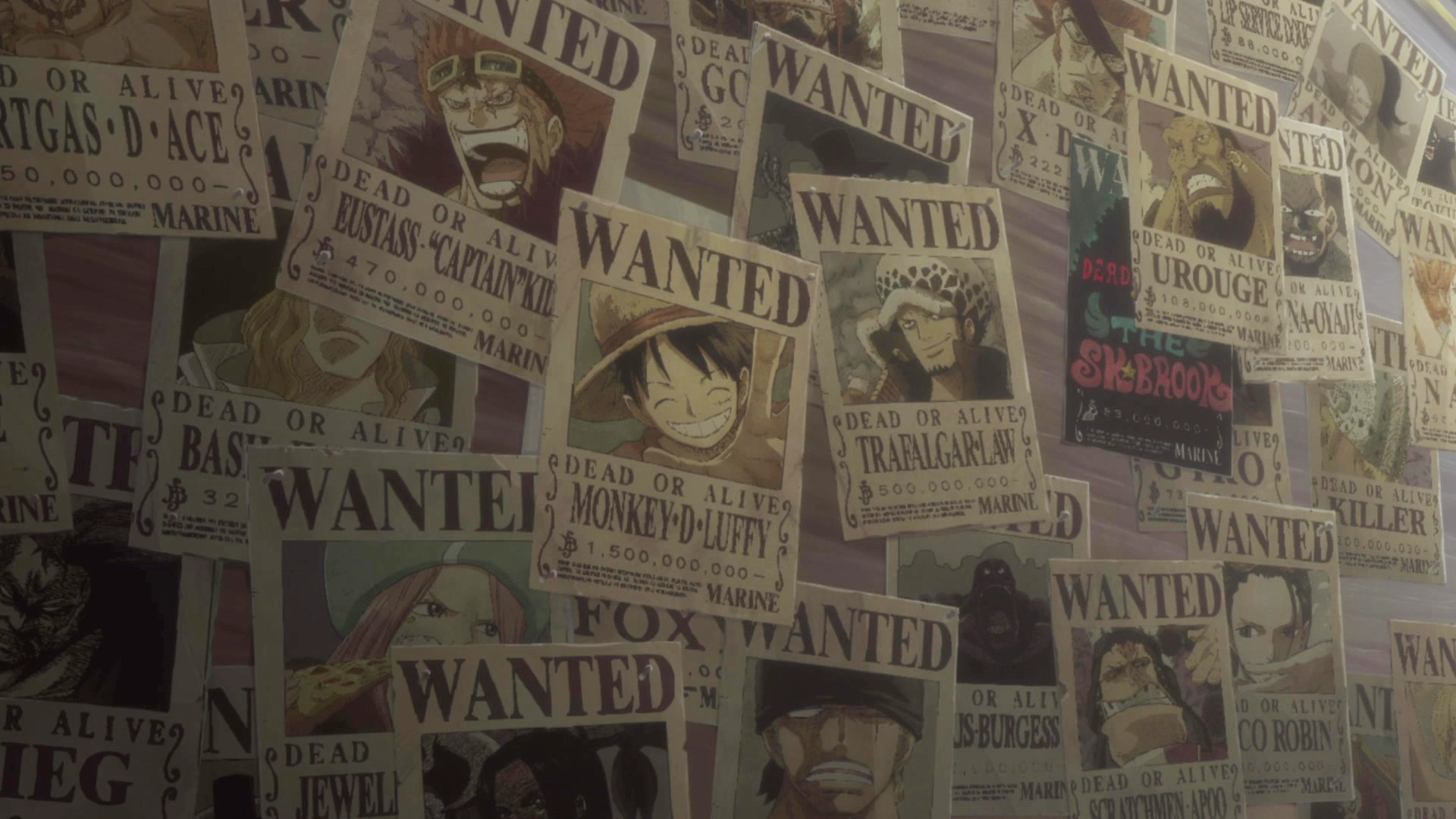
Bounties are conventionally issued through wanted posters: single, easily-portable leaflets depicting each criminal's portrait, name, and reward amount. These are regularly circulated by News Coos across the world, and are commonly posted in public locations such as taverns for civilians, as well as being kept by Marine bases and ships for reference.

The portraits used for wanted posters are typically high-quality photographs, taken by specialists from the Marines' Photography Department. However, their resources are not infallible; if no suitable photograph is available, an artist's rendering may be used instead. Like reward amounts, portraits may be updated to reflect significant changes, such as aging or disfigurement, or if a better image is found.
Wanted posters generally print the criminal's full name whenever possible (though active use is prioritized over all, hence Franky's poster printing his adopted name rather than his birth name). In very rare cases, an epithet may be included as part of the name. As seen in the above and below images, all wanted posters are written in English and the criminal's name is printed in English letters.
Effects
Bounties can be highly effective in publicizing and ostracizing criminals from lawful society, and are hence despised by those like Kuro (and, to a lesser extent, Nami) who enjoy such comforts. Indeed, a bounty can turn entire communities against even children, as with Nico Robin in the wake of the Ohara Incident.
On the other hand, those—especially pirates—who embrace criminality and notoriety hold bounties in considerable pride. The male Straw Hat Pirates display theirs near the Thousand Sunny's sleeping quarters (with Sanji particularly opinionated on both his bounty amount and portrait), and regularly celebrate any increases; these celebrations are often shared by their friends and allies, civilians included.

If a person wears a disguise that makes them look different, and they are recognized by that disguise, then they can fool the system, as shown with Charlotte Cracker, and also to a lesser extent Usopp whose first official bounty was credited to his "Sogeking" persona rather than to himself.
Nevertheless, both criminals and professional law enforcement commonly use bounties a shorthand for strength. Stacking them against regional averages helps determine threats in relation to location; for example, the average bounty in the East Blue is 3,000,000, bounty heads worth 10,000,000 or more would be considered noteworthy. Since East Blue is defined as the weakest of the four seas outside of the Grand Line, the West Blue, North Blue, and South Blue must all have higher average bounties and have a greater number of famous criminals hailing from their waters. However, pirates of the Grand Line tend to have the highest bounties, as pirates in Paradise can have bounties up to 100,000,000, and New World pirates can have bounties surpassing 1,000,000,000. Any bounty that goes to 1,000,000,000 or over is considered monstrous, even in the New World. High-ranked subordinates of Four Emperors are known to surpass or get close to those figures occasionally since their bounties tend to raise in tandem with their captain's.
While the details of how high a bounty could be are unknown, the greatest amount revealed in the first half of the story was that of Whitebeard Pirates 2nd division commander and son of Gold Roger Portgas D. Ace, worth 550,000,000. The current highest active bounty is that of the former Emperor Kaidou with a bounty of 4,611,100,000.
While a pirate with a bounty of 300,000,000 is still considered a rookie, once a pirate exceeds that value it is difficult to get any higher, and it seems that 400,000,000 is enough to be considered an elite pirate. While the Seven Warlords are also important pirates in the world, some of their former bounties are not particularly high. However it should be noted that these are their former bounties which do not represent the threat that they could have achieved as active pirates. After Jinbe had resigned, his bounty increased to over 400,000,000.
In terms of piracy, any rookie who has earned a bounty of over 100,000,000 is considered particularly dangerous and noteworthy, and is considered a "Supernova". The Worst Generation is a group of eleven Supernovas rising to power during the Great Pirate Era, who almost simultaneously appeared on Sabaody Archipelago. Each holds a bounty of over 100,000,000 and all have advanced into the New World.
Earning a large bounty in a relatively short period of time also gives the pirate notorious attention and a global reputation. After earning a bounty of 80,000,000 in a single campaign, the World Government offered Boa Hancock a position among the Seven Warlords of the Sea. Blackbeard believed he could become a Warlord if he defeated Monkey D. Luffy, whose bounty had jumped from 30,000,000 to 100,000,000 following the defeat of Baroque Works and their leader Crocodile. Blackbeard would settle for achieving his goal by turning in Portgas D. Ace instead, since Ace had caught up with him and Blackbeard emerged victorious.
According to Bellamy, it is common for pirates to exaggerate their bounties and even forge wanted posters to build up an intimidating reputation. However, no actual instances of this (apart from the Fake Straw Hat Crew, who were impersonating legitimate bounty heads) have been seen thus far.
Variants
Thus far, at least four other bounty/wanted systems have been known to exist outside the standard World Government system:
Fish-Man Island
For a time, the Ryugu Kingdom of Fish-Man Island circulated posters for Vander Decken IX (and possibly his ancestors). These, notably, were headed with "DANGER" and displayed neither "DEAD OR ALIVE" nor a specific bounty.

Decken's most noteworthy crime was using his power to mark the king's daughter as his target, so that any weapon he threw would fly straight toward her, no matter how far away she was or where she tried to run away to. He used this threat to demand her hand in marriage, forcing the kingdom to hide the Princess away in an armored tower.
Donquixote Pirates
When he ruled as king of Dressrosa, the Warlord Donquixote Doflamingo freely issued bounties on criminals (i.e. anyone that threatened or opposed him). It was presumably this authority that placed Kyros—during his time as "Thunder Soldier"—on a wanted poster, though his poster (like Decken's) displayed neither "DEAD OR ALIVE" nor a specific bounty.

Later, after the truth about Doflamingo and his crew was revealed to the people of Dressrosa, he entrapped the entire country in his "Torikago" technique and forced the entire population into a nation-wide survival game. Doflamingo placed bounties on those responsible for his Underworld operations falling apart, consisting of five of the Straw Hat Pirates and seven independent allies opposing the Donquixote Pirates' rule. Each bounty was rated on a scale of one to five stars, determined by how much Doflamingo personally hated them. Each star promised 100,000,000 for their capture.
Wano Country
Kurozumi Orochi's reign over Wano Country, much like Doflamingo's, used wanted posters to identify personal and political enemies as criminals. Notably, posters were issued for Roronoa Zoro ("Zorojuro") and Killer ("Kamazo") shortly after they arrived in Wano, as well as all involved in stealing Shimotsuki Yasuie's executed body away.
Due to Wano's isolationism, these posters used all-Japanese text, and hand-drawn illustrations instead of photographs. The "Zorojuro" and "Kamazo" posters also included a full list of charges.
Cross Guild
The Cross Guild, an organization established by three former Warlords of the Sea, Dracule Mihawk, Crocodile, and current Emperor Buggy has begun issuing bounties for Marines. Similar to the bounties placed by Doflamingo, the bounty amounts are indicated by symbols rather than monetary units.

These symbols include stars (★) or crowns. The number of stars or crowns identifies how much the Marine in question is worth. Each star is worth 100,000,000 and is offered in chests, while each crown is worth 1,000,000,000. Marines are usually assigned a standard amount based on their rank, although exceptions can be made if the Marine in question has a famous reputation, making them worth more money. Vice Admiral Garp for example is worth the same as an Admiral.
The standard bounties are:
Fleet Admiral: 5 crowns (5,000,000,000).
Admiral: 3 crowns (3,000,000,000).
Vice Admiral: 5 stars (500,000,000).
Rear Admiral: 2 stars (200,000,000).
Captain and Commodore: 1 star (100,000,000).
Infantry and Sailor Division ranks: 100,000.