

Pirate
Contents
A pirate is, broadly speaking, any professional criminal that operates wholly or partially on the Blue Planet's seas, especially people conducting robbery by ship. In most, if not all, cases they lead or belong to a group of like-minded criminals, known as a crew and the acts they commit are referred to as piracy.
Though not the only existing type of criminal, pirates appear to comprise most of the world's significant bounty heads, and—with the possible exception of the Revolutionary Army—constitute the strongest opposition to the authority of the World Government and Marines.
The first pirate in history was Joy Boy, who sailed 900 years ago during the Void Century.
On the Blue Planet, perhaps the trait most universal to pirates, beside their sea-going activities and general defiance of the law, is the Jolly Roger, a skull-and-crossbones symbol for intimidation. This symbol, usually displayed on a pirate ship's flags and sails, exists in countless variants for every pirate group. Its overall connotations are strong enough that the Marines have been known to attack ships flying it on sight, even if those onboard are not identified with any particular bounty or crime.
While the majority of pirates are male humans, it is not unheard of for women, fish-men and merfolk, giants, minks, and even non-sapient animals to also sail under a Jolly Roger and attain comparable reputations.
Pirates are stereotypically cast as greedy, violent and ruthless, willing to hurt innocent people and destroy property to gain what they want, be it treasure, power, or even simple personal amusement. For this reason, civilians commonly fear and detest pirates on principle, even if they have never met one in person before.
In reality, pirates may have a wide variety of motivations and ambitions, from the stereotypical greed and cruelty to sheer adventurousness or pursuit of some idealistic dream. Notably, the Straw Hat Pirates, who care very little for treasure or material wealth, and value companionship above all else. As such, some law-abiding individuals and communities are known to romanticize pirates, or at least tolerate them within reason:
Generally, the Marines do not pursue otherwise law-abiding people simply for aiding or associating with pirates, though exceptions can and have been made for particularly notorious cases. They do tend to discourage children from admiring pirates or pursuing such a career, and undercover Marine Donquixote Rosinante even tormented children to dissuade them from joining the Donquixote Pirates while working undercover among the crew. However, ironically, the World Government itself is often directly or indirectly responsible for instigating people to become pirates or live a life of crime.
Nico Robin is the only survivor of the island Ohara, which was destroyed due to its residents studying the Poneglyphs. Hiding the truth from the world, the government gave her a bounty of 79,000,000 belly at the age of eight, forcing her to live a life of crime to survive. Another very similar case is Trafalgar Law, who is the only survivor of the country of Flevance, which was destroyed by Amber Lead Syndrome. Despite knowing that the ore was poisonous and toxic, neither the royal family nor the World Government bothered to warn the citizens and this in turn led to the entire country becoming sick, quarantined and killed by neighboring countries, with Law being the only survivor. This traumatic experience left him so psychologically unstable that it transformed him into a cruel, merciless, angry and cynical child, wanting to become a pirate to destroy as many lives as possible before his seemingly inevitable death.
As being a pirate is a serious crime in the eyes of the World Government, pirates are assigned bounties. The stronger the pirate is in combat, or the more serious the crimes they have committed, the higher their bounty will be. Depending on their bounties, captured pirates are either sent to prisons such as Impel Down or given public executions. While not all pirates enjoy having a bounty on their head, a number of them take pride of the notoriety that comes with it, even going as far to try increasing it by taking down other notable combatants in order to gain evil fame.
It also seems that many members of the World Government and Marines know that not all pirates are bad; Despite being enemies under the law, Koby and Luffy are close friends and trust and respect each other a lot. Garp also states that he did not hate Roger, who was the Pirate King and the biggest threat to the World Government when he was alive, Roger even entrusted Garp with the safety of his unborn child. The Five Elders also recognize that Shanks, one of the Four Emperors, does not have world conquest as an ambition and would likely not cause trouble in the world just for fun. The World Government also tries to prevent any news of any heroic act done by pirates from spreading throughout the world; The World Government gave Smoker and Tashigi credit for defeating and capturing Crocodile and saving the Arabasta Kingdom, when in fact, the ones responsible were the Straw Hat Pirates.
As noted by Nami, the government makes pirates scapegoats, making them appear responsible for all the crimes and problems in the world, while the World Government is viewed favorably as the protectors of the people by the general population. But ironically and hypocritically, because of the "Heavenly Tribute" that affiliates of the World Government must pay for protection, many poor countries or communities must rely on pirates themselves for protection from other criminals or threats. The Four Emperors, for example, have many territories under their protection.
Though it is rare, occasionally there are pirates that form single-person crews and sail the seas solo, without ever gathering crewmates. Prime examples of these are the former Warlords Bartholomew Kuma and Dracule Mihawk.
Monkey D. Luffy's hometown, Foosha Village, served as a safe haven for the Red Hair Pirates for over a year, strongly influencing Luffy's own childhood dream to become a pirate. The village continues to celebrate, publicize and take pride in Luffy's accomplishments, with only the mayor ever objecting.
The other Straw Hat Pirates' hometowns are also known to welcome certain pirates, even if they have faced cruel treatment by pirates in the past.
Water 7's shipyards are entirely willing to service pirates as long as their shipbuilding prices are met, and no violence is threatened. The mayor himself owns the Galley-La Company, which built the Straw Hat Pirates' ship.
Fish-Man Island freely welcomes pirates as tourists, despite the ongoing problem of pirates kidnapping merfolk and fish-men to sell as slaves. The island was also protected by the Whitebeard Pirates until their disbandment, and later became protected by Big Mom, and is currently protected by the Straw Hat Pirates.
Skypiea, Fish-Man Island, and Dressrosa idolize the Straw Hat Pirates as heroes for defeating figures who posed even greater threats to their respective communities.
Some communities rely on pirate crews for protection against other criminals, though only the most powerful crews are capable of doing this. For example, the Whitebeard Pirates protected many territories and islands up to its dissolution, and the Wano Country was previously protected by the Beasts Pirates under the Kurozumi shogunate. After Kaidou's defeat and the death of Kurozumi Orochi, the Kouzuki Family resumed control of Wano, and it is implied that it is now under the Straw Hat Pirates' protection.
Crews
Virtually all pirates exist as part of a pirate crew, comprising of other pirates willing to operate under the same Jolly Roger. Inside a crew, everyone is responsible for certain duties, some related to the leadership of the crew, and others related to specific professions that are crucial to keep the crew operational.
Leadership positions include:
Other positions common to pirate crews include:
There are other positions on a pirate crew as well. They are less common and less obvious. Such positions include:
Usually, a pirate crew recruits new members at the sole discretion of the captain, who may set strict, objective standards: Demalo Black of the Fake Straw Hat Crew demanded only captains strong enough to have earned a bounty of 70,000,000 or more, and Charlotte Linlin of the Big Mom Pirates demanded new recruits create marriage ties to her blood relations. Other crews may have no standards at all besides personal fondness for the individual.
Some captains may also force unwilling individuals to join their crew; Koby was taken as a slave by the Alvida Pirates and forced to be a cabin boy, and the Beasts Pirates are known to gain power by capturing previous enemies and forcing them to serve Kaidou. Furthermore, the traditional pirate game known as the Davy Back Fight allows the winning captain to poach crew members from the losing crew, who must change their allegiance without complaint.
Pirate crews tend to be named after their captain, whether directly or through an epithet or personal motif. Some crews are named after a common race or origin shared by all members or a symbol which the captain feels represents the crew.
Some pirate crews pledge themselves subordinate to another, more powerful crew. In practice, this means that the subordinate crews are loyal to the higher captain but are otherwise free to act independently under their own captain. Examples of subordinate crews include the 43 subordinate crews of the Whitebeard Pirates, and the Bellamy Pirates under the Donquixote Pirates.
Captain, who is the highest-ranking leader of the crew and decides (or at least has final authority) on all major actions taken by the crew. The captain also often possesses the greatest combat ability and notoriety out of the entire crew.
In some cases, a captain can be called Admiral, if the crew owns several ships or commands many subordinate crews.
First Mate or Vice-Captain, who is second-in-command of the crew. The first mate advises the captain, relays orders to the rest of the crew, and usually assumes authority in the captain's absence. The first mate also often possesses the second greatest combat ability and notoriety out of the entire crew. The position is usually held by the first crew mate the captain recruited when the crew was founded.
Chief of Staff or Staff Officer, who serves the captain and first mate as a liaison to their subordinates. The chief of staff is usually next in line to take over as captain after the first mate.
Officers, usually seen in a larger pirate crew, are a select few elite combatants who command the lower-ranked members of the crew.
In some crews, the officers are further divided into higher (elite) and lower (regular) officers. The higher officers are stronger and hold authority over the lower-ranked officers.
Combatants, who specialize in fighting and, depending on the crew's size and focus, may or may not have other skills. Different types of combatants include, but are not limited to:
Swordsmen, who specialize in using swords for combat.
Snipers, who specialize in using ranged weapons, such as firearms, a slingshot, or a bow and arrow.
Martial Artists, who specialize in utilizing their own bodies for combat, using punches, kicks, and other melee attacks.
Assassins, who are usually sent to neutralize a specific target for the crew's purposes. Their skills, weapons, and combat techniques can vary. Unlike the other types of combatants, assassins actually go looking for their enemies, whereas other combatants more often fight as needed when their opponents come to them.
Navigators, who are in charge of planning the ships course to their next destination and making sure the ship safely avoids obstacles, like storms.
Cooks, whose purpose is to prepare meals to keep the crew fed.
Doctors, whose purpose is to keep their crew mates healthy, treating illnesses with medicine and bandaging any injuries they sustain.
Shipwrights, who are in charge of maintaining, repairing, and upgrading the crew's ship.
Helmsmen, who take the ships helm and steer the ship at the navigator's instruction.
Lookouts, who keep an eye out for things like islands, enemy ships, or changes in the weather and inform the rest of the crew when such things are near. They usually keep watch from a high vantage point, like the ships crow's nest.
Musicians, who specialize in playing music to keep the crew entertained, given that the crew's daily duties can be monotonous.
Scholars, who act as researchers for the crew, providing an intellectual perspective and information that could prove useful to the crew's operations. Scholar types include:
Archaeologists, who specialize in the historical study of past cultures and ancient ruins.
Scientists, who specialize in several areas, like engineering, chemistry, and biology, to help the crew with their creations and knowledge.
Apprentices, recruited at a young age, who may be used for anything from unpleasant chores to open combat. Though the position carries little authority or respect in itself, it can serve as a valuable opportunity for future pirates to develop their skills and gain added notoriety.
Ship Guards, who are tasked with protecting the ship, preventing it from being stolen or taking damage. They usually stay aboard the ship, even when the rest of the crew heads ashore or goes into battle.
Gunners, who operate the cannons of the ship.
Torturers, who specialize in punishing and/or obtaining information from captured enemies by means of inflicting pain.
Information Brokers, who specialize in obtaining and trading for information through a network of contacts, usually affiliated with the criminal underworld.
Intelligence Officers, who specialize is espionage tactics, as well as analysis and assessment.
Pets, animals who usually serve as companions, but can also be combatants depending on their abilities.
Ships
All but the newest (or poorest) of pirates sail on specialized ships, often custom-built, that bear their corresponding Jolly Roger on its mainsail and/or flags; in most cases, the figurehead is also customized to reflect the captain's epithet or personal motif. Apart from this, a pirate ship may be of any size and equipped with any level of technology and weaponry, depending on the skills and materials available to—and ambitions of—its crew. Most ships use cannons as their primary means of defense, though ships such as Thousand Sunny has been equipped with various other enhancements and features.
Of course, as criminals, very few pirates have qualms about stealing or hijacking new ships when the need arises. Don Krieg, for instance, was infamous for using civilian and Marine ships to facilitate sneak attacks. However, some pirate crews treat their ship as a member of their own crew, especially considering how some ships can be sentient beings themselves.
Territories
A sign of a pirate's power is their ability to gain and control territory, from a small island to a base over several villages. Often, to stay out of sight, they will keep their base hidden like the Kid and the Fire Tank Pirates.
Because of their great power, many of the Seven Warlords of the Sea became known as celebrities within their respective countries up to the program's dissolution. On the other hand, the Four Emperors tend to have from islands to archipelagos under their control.
While some pirates have managed to rule as royals over a specific territory there has yet to be a true "pirate nation"—that is, a globally-recognized nation predominated by pirates in general. Building such a nation has driven the ambitions of Crocodile, Kaidou, and Marshall D. Teach, among others.
Categories and Classes
While pirates operate in all of the world's known seas, different crews can vary sharply in power, scope, and notoriety. These disparities are often reflected by a crew's area of operation:
It should be noted that these designations are largely informal, with (at best) vague parameters. They stand in contrast to the more formalized categories and titles listed below.
Those in the Four Blues (East Blue, West Blue, North Blue, and South Blue) are typically home to weaker, lesser-known pirates. According to Mihawk, East Blue in particular is known as the weakest sea. As such, the World Government has little to no presence in these seas, leaving law enforcement to low-ranking Marines.
Those who successfully enter the first half of the Grand Line are commonly deemed rookies and paid more serious attention by the World Government and older pirates, though not universally.
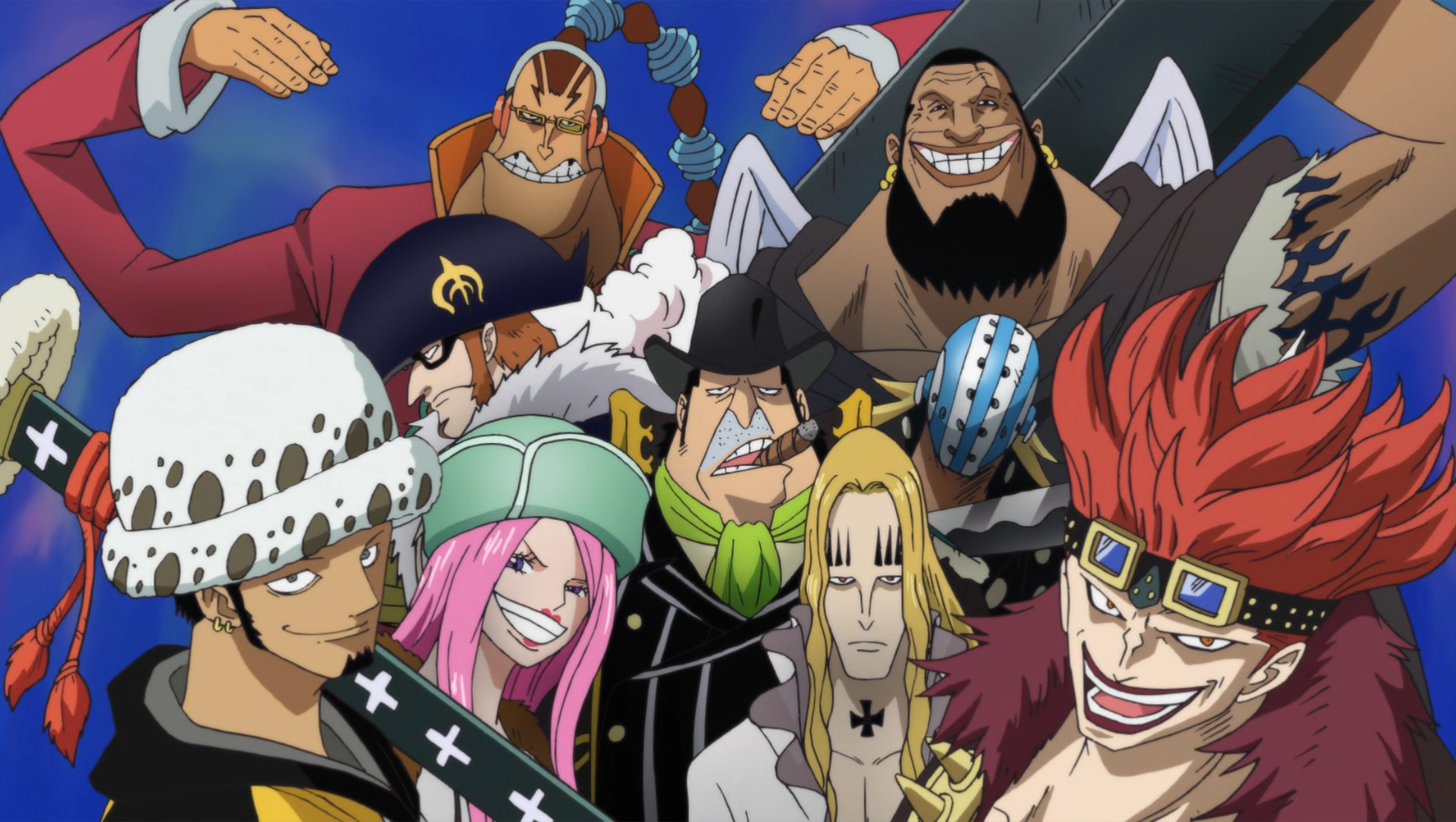
Rookie pirates with bounties surpassing 100,000,000 are deemed exceptional, and categorized as Super Rookies or Supernovas. Eleven particularly powerful pirates became known as part of the Worst Generation, though they are by no means the only ones.
Those who establish significant reputation and influence, particularly after crossing the Grand Line's first half and entering the second half, may be deemed Great Pirates. Thus far, only six individuals (Shanks, Edward Newgate, Charlotte Linlin, Kaidou, Gol D. Roger, and Monkey D. Luffy) have been given this descriptor.
Seven Warlords
The Seven Warlords of the Sea were a selection of seven pirates legally sanctioned by the World Government. While not employees or officials per se, they were allowed to pursue most pirate activities without threat of arrest (their bounties being frozen), along with a number of other extralegal privileges. In return, they were expected to further the World Government's interests, mainly by giving over a share of their plunder (and, implicitly, making other pirates their main targets).
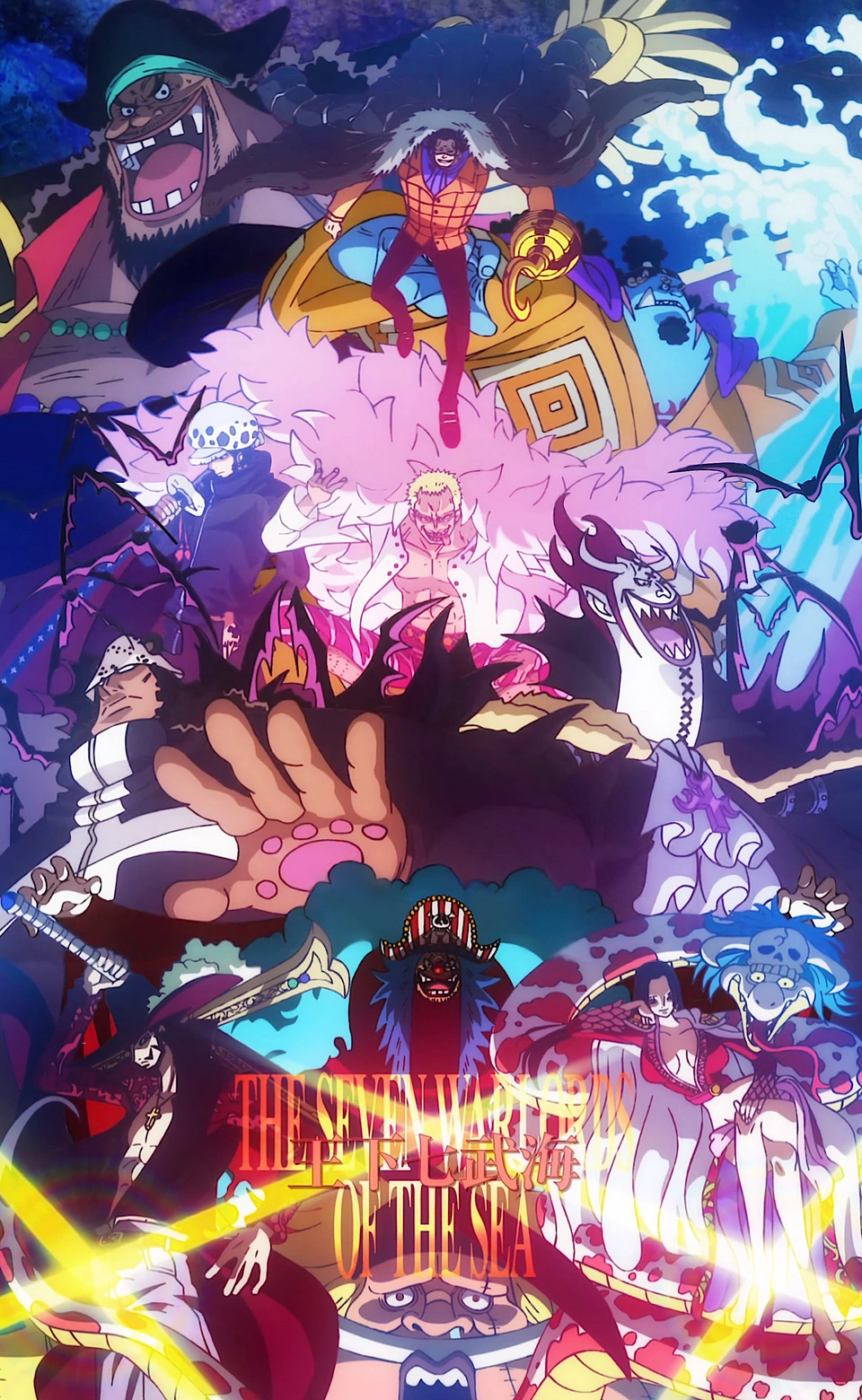
Warlords are recruited somewhat arbitrarily, but always with a focus on power and notoriety; as such, they are widely feared (and/or reviled as "government dogs") by most other pirates. Even so, they vary widely in abilities, methodologies, and personalities, some operating alone while others maintain full crews and are even acknowledged as legitimate sovereigns.
In any case, Warlord status always relied on the World Government's favor, and members could lose it in many ways, including subversive acts, defiance of critical orders, or merely being judged too weak to intimidate common pirates. Warlords stripped of status would face the standard treatment of pirates: arrest and imprisonment (often in Impel Down), if not immediate death.
After Crocodile and Donquixote Doflamingo were both found to be abusing their powers to directly undermine major World Government kingdoms (Arabasta and Dressrosa, respectively), the Council of Kings moved to abolish the system completely, revoking all privileges of current Warlords, making them fugitive again.
Four Emperors
The Four Emperors are four highly notorious New World pirate captains currently recognized as the strongest pirates in the world. Of the seven known pirates to hold this title, three were formerly members of the infamous Rocks Pirates while two others were former members of the Roger Pirates. There is a strong degree of overlap between the Four Emperors and those who are considered Great Pirates, with the original four all being known as such. As the strongest and most influential pirates in the world, a certain level of strength and prestige is needed to be recognized as an Emperor. The Four Emperors and their subordinates are considered one of the Three Great Powers of the world, along with the Marines and (formerly) the Seven Warlords of the Sea.

Pirates regarded as Emperors are extremely powerful in combat, captain notoriously strong (and often large) crews, and hold immense levels of influence over the politics of the New World. Typically, emperors will own territories; they may either be the official rulers of their territories or give the rule to puppet leaders but maintain de facto rule. In addition to this, it is not uncommon for pirates of this level to have other notable crews serving under their own as subordinates.
The title of Fifth Emperor was spontaneously given to Monkey D. Luffy by Morgans of the World Economy News Paper following his confrontation with Big Mom in Totto Land. It should be noted that this title is both unofficial and unrecognized by the World Government or the Marines. Additionally, Luffy officially became one of the Four Emperors after the events of the Raid on Onigashima, after he formed an alliance which defeated two other Emperors, Big Mom and Kaidou.
With the positions of Emperors having a vacancy after Kaidou and Big Mom's fall, the positions were given to Monkey D. Luffy and Buggy respectively.
Pirates considered Emperors of the New World are known to have many extremely impressive feats under their belt. Red-Haired Shanks, the one who has held the title the longest among the current Four Emperors lineup, is known to have regularly dueled against the strongest swordsman in the world prior to losing his arm. Edward Newgate was widely known as the late Pirate King's career-long rival. All pirates to be referred to as Emperors hold extremely high bounties, all of which exceed one billion belly. Currently, the Emperor with the highest active bounty is the former Emperor Kaidou, who was dubbed the Strongest Creature in the World. However, the status of his bounty remains unclear as it is uncertain whether he is still alive. When fully assembled, a pirate crew of this level may even be strong enough to stand a chance in a battle against the entire Marine force and Seven Warlords of the Sea, as demonstrated during the Summit War of Marineford.
Pirate King
The Pirate King is a title applied to the greatest pirate alive. The only pirate universally recognized with this title is Gol D. Roger, who intrinsically linked it with the mythical treasure known as One Piece. Following his death, countless pirates have warred against each other for the title; as yet, no one has "officially" secured it.

Before his death, Roger hid the One Piece in an unknown location—popularly believed to be Laugh Tale, the final island of the Grand Line. The frenzy over discovering and owning such an immense treasure sparked the "Great Pirate Era". The title of Pirate King will be given to the next person to find the treasure.
During the last portion of his life, Edward "Whitebeard" Newgate was popularly acknowledged as the man closest to being the next Pirate King, though he admitted to having no personal interest in the title (some, such as Donquixote Doflamingo, arguing that he would have long won it otherwise). Many of Luffy's allies, such as Vivi and Koby, believe that he is destined to become the Pirate King, as he shares many similarities with Gold Roger; Kokoro also addressed Luffy as the Pirate King and Shakuyaku has stated that both she and Silvers Rayleigh were rooting for Luffy to achieve this goal.
The reasons for a person wanting to obtain the title Pirate King vary; those like Buggy, Gecko Moria and Blackbeard wish to acquire it for power and influence, while others like Luffy and formerly Crocodile simply hold this goal as a personal dream. The Four Emperors are considered the most likely candidates for this title due to their sheer strength. Among them, Blackbeard, Big Mom, Kaidou, and Buggy have shown interest in earning the title. Luffy seems to simply desire it for the adventures and fun that come with it, but has admitted to Shanks, Ace, Sabo and the rest of his crew that for him, becoming the Pirate King is a necessity for fulfilling an even greater, unknown dream that he has admitted only to them. However, Ace accidentally told Yamato what Luffy's greater dream was through an accidental slip of tongue, unbeknownst to Luffy.
The Pirate King is said to be the ruler of the sea, something that Luffy confirmed when asked about it by Enel. However, Luffy also noted that the Pirate King is not the most powerful or wealthiest person in the world, but simply the person with the most freedom on the sea. Rayleigh notes that Gold Roger also held a similar belief.
One thing is for certain; the journey to become the next Pirate King is very long and dangerous. Mihawk states that such a goal is far more difficult than challenging him for the title of the "Strongest Swordsman in the World." After the death of Portgas D. Ace at the hands of Akainu, Luffy considered giving up his dream after seeing how powerless he was until he was reminded of those who believed in him by Jinbe.
The title of Pirate King is not limited to men, as Big Mom pursued the title despite being a woman.
Before the Great Pirate Era
Pirates have been present in the world for at least 900 years; with the first known pirate being a mysterious figure known as Joy Boy.
During the Void Century, a time period whose information has been heavily censored by the World Government, Joy Boy left a mysterious treasure on the final island of the Grand Line. This treasure would become the target of many pirates, but remain unfound for another eight hundred years. Nefertari D. Lili's act of scattering the poneglyphs across the world is regarded as influencing pirates to chase them in pursuit of treasure.
The oldest known group of pirates mentioned were co-captained by two generations of giants—Jorul and Jarul, then Dorry and Brogy—for hundreds of years. However, despite pirates existing back then, none became noteworthy enough to have a major influence on the world.

Approximately forty years ago, the Rocks Pirates became an extremely prominent pirate crew, comprising many people who would later become recognized pirates themselves. However, two years later, Gol D. Roger, and Monkey D. Garp of the Marines fought a demon-turned Rocks leading to the pirate captain's defeat and death at the hands of the Knights of God. Rocks' crew disbanded, and many members would form their own pirate crews and accrue wealth and power. Meanwhile, Roger would become the first pirate to successfully find Joy Boy's treasure, and the first recognized Pirate King.
At the height of his notoriety, Roger—long battling a terminal illness—surrendered himself to the Marines, and was quickly sentenced to death. However, during his public execution, he declared that he, much like Joy Boy, had hidden his treasure for the next Pirate King to find. This led to a deluge of new pirate crews seeking the treasure, known as the One Piece, sparking what came to be known as the Great Pirate Era.
The Great Pirate Era
The Great Pirate Era, also known by some as the Era of Whitebeard, saw an unprecedented increase of pirate activity throughout all seas of the world. However, the world of piracy would become dominated by three prominent pirates formerly serving under Rocks: Edward Newgate (Whitebeard), Kaidou, and Charlotte Linlin (Big Mom). These three infamous pirates, as well as the young addition Red-Haired Shanks, would go on to form the Four Emperors, four extremely powerful pirates considered to be the strongest contenders for the title of Pirate King. Other prominent young pirates, such as Dracule Mihawk, Crocodile, Donquixote Doflamingo, and Gecko Moria, were inspired by Roger's words and gained infamy during this time as part of the World Government's sanctioned group of pirates, the Seven Warlords of the Sea.
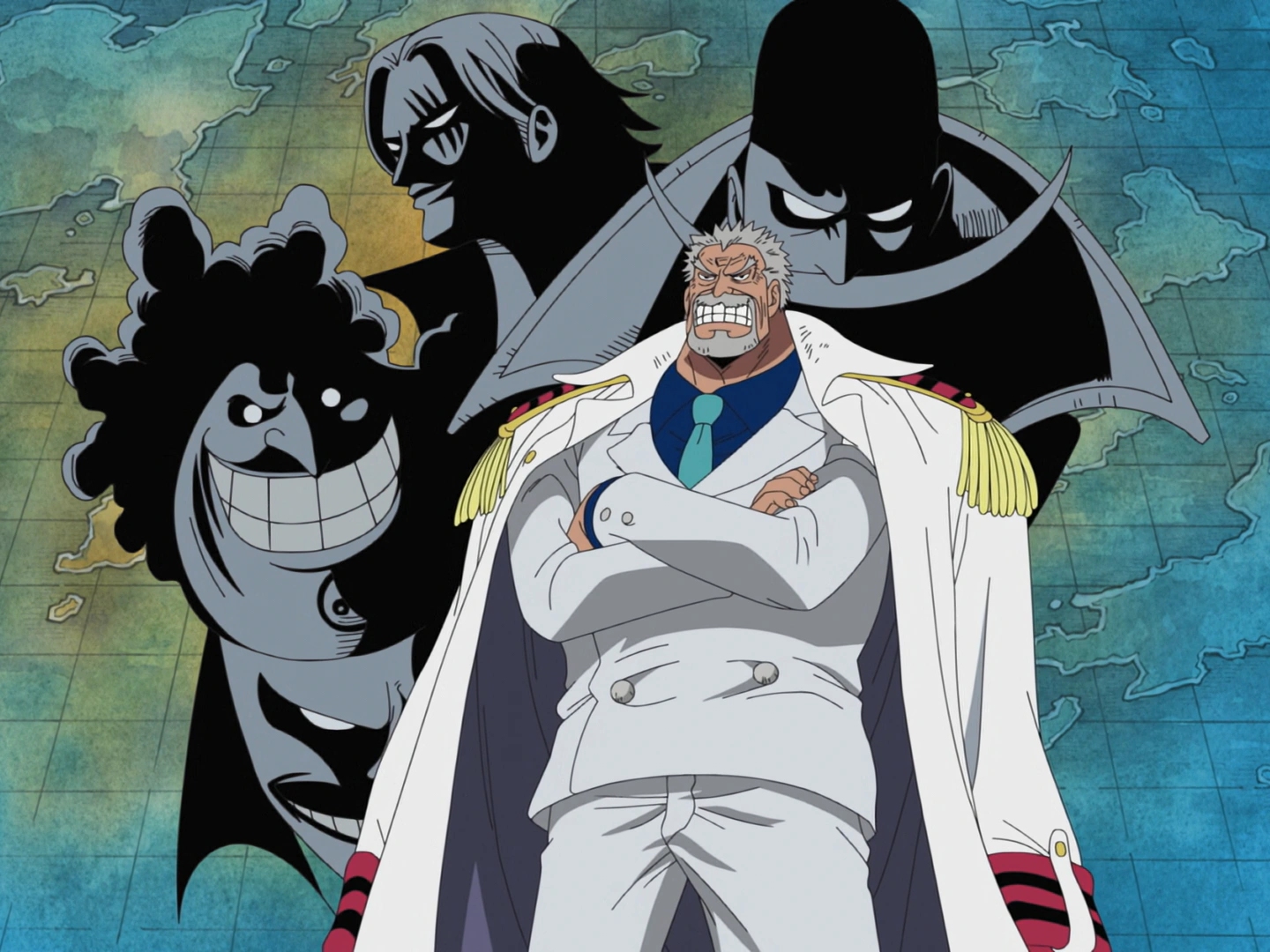
Over the next several decades, the old figures from before the Great Pirate Era began to disappear due to the span of time. This left fewer and fewer people aware of the days of piracy before Roger's death. Many old values shared by the pirates from before the Great Pirate Era began to decline. Even once-ubiquitous songs such as Binks' Sake have begun to fade out of memory, save from the minds of those who still remember the old days of piracy (such as Brook and Shanks). Although newer pirates still adopt these values, some went in their own direction and their own vision of a "New Age"; for instance, Bellamy's vision of a New Age involved ignoring legendary treasures in favor of readily-available treasures which were already plentiful. Although the Four Emperors remained the most powerful figures in the pirating world, it is during this time that younger pirates, dubbed "rookies," would emerge. Eleven particularly powerful rookies became part of what is known as the Worst Generation.
In response to the increase of pirate activity, the World Government formed the Seven Warlords of the Sea, a group of seven government-sanctioned pirates who would hunt down criminals the government viewed as a threat. However, this program was largely ineffective in stopping many influential pirates from taking the world stage. Furthermore, the credibility of this program was harmed by Crocodile, who abused his privileges to facilitate an attempted coup-d'état against the Arabasta Kingdom, only to be stopped by a criminal pirate, Monkey D. Luffy.

The Great Pirate Era ended with the Summit War of Marineford. This occurred because the Marines successfully captured Portgas D. Ace, one of Whitebeard's closest confidants and division commanders. This led to an intense war on the Marine Headquarters of Marineford, which ultimately ended with both Ace and Whitebeard's deaths; Whitebeard would be replaced by Marshall D. Teach ("Blackbeard") as an Emperor. Despite the war ending in an overwhelming victory for the Marines, Whitebeard's last words confirmed the existence of the One Piece. This declaration reignited the pursuit of Roger's legendary treasure, and yet again inspired new pirates to emerge in search of the treasure. This would mark the end of the old Great Pirate Era and the beginning of the New Age.
Even the people of Luffy's hometown noted the increase in pirate activity in the seas after the war. To counter this, it has been stated that the Marines have now been granted unprecedented power by the World Government.
The New Age
The New Age, also known by some as the Era of Blackbeard, is an era lasting from the Summit War up to the present day. It is during this era that the original Four Emperors would experience a decline in power and be replaced by the quickly rising pirates of the Worst Generation.

As such, the World Government began to grant increased power to the Marines to combat the ever-growing number of pirates. The Marines' fleet admiral Sengoku retired and was replaced by Sakazuki, who would implement even more stringent policies against piracy. As the rookie pirates advance closer to the One Piece, Sakazuki would reposition Marine Headquarters to the New World to allow for better law enforcement.
Despite this, the World Government would continue to lose power. One of the Seven Warlords, Donquixote Doflamingo, who ran an illegal operation with Kaidou of the Four Emperors in order to produce an army of SMILE users, attempted to destroy Dressrosa and, much like Crocodile two years prior, was defeated by Luffy and stripped of his title. As this was the second time a Warlord abused their privileges to commit heinous public crimes, the kings at the Levely decided to disband the Seven Warlords. This contributed to an even greater power imbalance in the world and was a significant blow to the World Government's power, though they now intend to implement the new SSG to supplant the seven pirates who were dismissed from their positions.
Perhaps the most influential event affecting the pirating world was the Raid on Onigashima, an intense battle in which a coalition comprising six members of the Worst Generation collaborated and successfully defeated both Kaidou and Big Mom. The fall of two of the Four Emperors marked the point where old pirate veterans became fully overtaken by young pirates.
Currently, the Four Emperors are Blackbeard, Shanks, Buggy and Luffy, the latter of which is suspected to possess the will of Joy Boy. All four of these pirates are growing ever closer to finding Roger's treasure, and it is apparent the pirating world as a whole is moving farther and farther out of the government's hands, with pirates everywhere seeming less and less mindful of the government. Since the establishment of Cross Guild and Vegapunk's worldwide broadcast, pirates of the world are more determined than ever to clash with the Marines for, not only the title of Pirate King and the legendary treasure One Piece, but in order to control the fate of the world itself.
Inspirations and Influences
Eiichiro Oda has, by his own account, been fascinated by pirates since watching the animated series Vicky the Viking as a child. Though well aware of their real-life brutality, he found their free-spirited and adventurous lifestyle ideal for a boys' manga, and began his first sketches as early as middle school.
As published, One Piece draws from pirate elements real and fictional, popular and obscure alike. Notably, a number of its characters are directly named after historical pirates:
-bgcolor="#cccccc" - Roronoa Zoro François l'Olonnais - Alvida Alwilda (Alfhild) - Morgan Henry Morgan - Bellamy Samuel Bellamy - Bartholomew Kuma Bartholomew Roberts - Edward Newgate "Blackbeard" Edward Teach - Marshall D. Teach - Thatch - Jewelry Bonney Anne Bonny - Eustass Kid William Kidd - Scratchmen Apoo Chui A-poo
Several broader elements of the setting also appear to have been inspired by aspects of real-life pirate history:
The "Great Pirate Era" launched by Gol D. Roger parallels the real-life Golden Age of Piracy, a period of much chaos and lawlessness, but also discovery and adventure.
"Pirate King" is a real epithet both English and Japanese have used for especially powerful and notorious pirates in history, including Henry Every (whose raids drew the highest-ever bounty for piracy) and Fujiwara no Sumitomo (among others that dominated Japan's Inland Sea).
The Seven Warlords of the Sea are similar to historical "privateers"—pirates officially commissioned by governments to pillage the ships and settlements of enemy nations. Privateers often had dubious legal standing even within their sponsor nations, and could easily be indicted as common pirates if they fell out of political favor, especially if they engaged in "extracurricular" pillaging against non-enemies.
Various other pirates throughout the series have engaged in similar deals: the Happo Navy, for instance, served the interests of the Kano Country until formally cutting ties. The Straw Hats themselves initially agreed to protect Nefertari Vivi (by extension fighting Crocodile and Baroque Works on the Arabasta Kingdom's behalf) only for a price.