
Lore
Eiichiro Oda
Professional mangaka, best known as the creator of the manga One Piece
Eiichiro Oda, born January 1, 1975 in Kumamoto City, Kumamoto Prefecture in Japan, is a professional mangaka, best known as the creator of the manga One Piece.
A dedicated writer and artist since adolescence, Oda began working for Shueisha's Weekly Shonen Jump at 17 and currently stands as one of the world's most prominent mangaka, earning an estimated ¥3.1 billion (US$23 million) per year. Despite his rigorous work schedule, he maintains steady correspondence with fans (and the wider public) through both formal interviews and informal channels such as his SBS columns.
Appearance
In real life, Oda is a Japanese man of average height, with few (if any) distinguishing features. When not in formal settings, he favors casual, Western-style clothing.
Like most mangaka, Oda typically uses outlandish caricatures to represent himself in printed works. The most common of these is a striped tropical fish, best known for "giving" all of Oda's weekly comments in Shonen Jump ' s table of contents; in more detailed depictions (such as the Color Walks' Monochrome Talk headers), this fish is usually given human ears and affixed atop a human body like a mask.
Personality
According to both himself and his editors, Oda is an ardent worker and perfectionist. By his own estimation, he sleeps only three hours per day during a typical work week.
During his first years at Shueisha, Oda was also noted to be unusually impatient and blunt for an aspiring mangaka, willing to argue with senior mangaka and editors on topics as major as story approval and minor as workplace music. This was gradually reduced through a combination of indulgence from the senior mangaka and discipline from the editors.
However, when interacting with fans—particularly in his SBS columns—Oda usually assumes a very laid-back, eccentric personality, eager to make jokes (especially those involving puns and/or toilet humor) and deprecate himself at any opportunity. Despite his age and status, he freely allows fans to address him with his grade-school nickname "Odacchi" (or the even more intimate "Ei-chan").
Per mangaka custom, Oda rarely allows himself to be photographed or filmed. He generally requests that print interviews be illustrated by his personally-drawn caricatures, and only agrees to video recordings if they take care to avert his face (or cover it up in post-production).
Interests and Hobbies
Oda is a fan of soul music, naming Brook Benton as his favorite in the genre. His other favorite musicians include Bryan Adams, Eminem, and Izumi Kato.
In his spare time, Oda enjoys watching films, both domestic and foreign; among his favorite are Seven Samurai, Nausicaä of the Valley of the Wind, Young Guns, Reservoir Dogs, and The Nightmare Before Christmas. Correspondingly, his favorite directors include Akira Kurosawa, Hayao Miyazaki, Quentin Tarantino, and Tim Burton, along with Baz Luhrmann and Masahiro Makino.
Oda has stated that he enjoys meat, and does not specifically dislike any food. Among Kumamoto's "native" offerings, he particularly recommends horse sashimi and mustard lotusroot.
Family
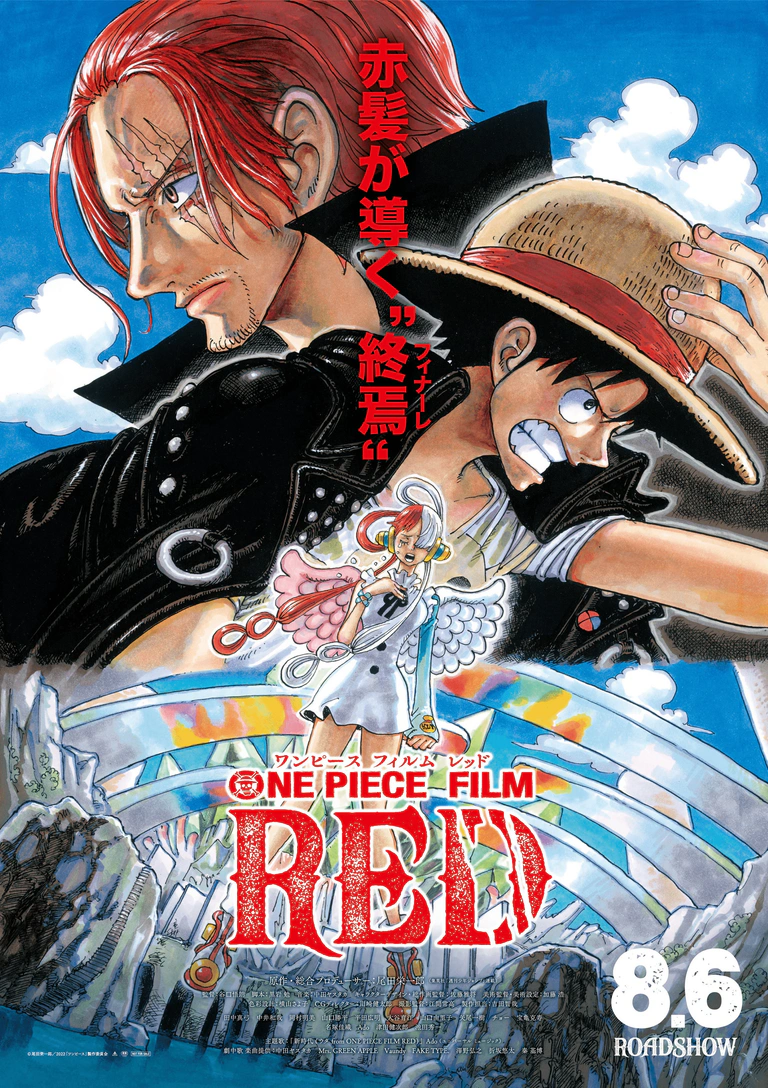
Little is known about Oda's parents. His mother Mieko Oda is an ordinary housewife, while his father Seiichiro Oda has worked as a salaryman while oil-painting as a hobby. In November 2018, his parents made a public appearance at the unveiling of Luffy's bronze statue, a part of the Kumamoto Revival Project. In 2022, Oda revealed that his 77-year-old father had told him that he cried while watching One Piece Film: Red. Oda has at least one sibling, an older sister whom he has mentioned in his SBS columns. In 2006, his sister married a French man named Cyrille.
Eiichiro Oda's wife is Chiaki Inaba (born Kanagawa prefecture, Kantō, Japan, January 4, 1978). Inaba is a former model, actress, tarento, "Campaign Girl", "Race Queen" and "Gravure Idol". She was active from the mid-1990's to early 2000s in television shows and magazines in Japan. Inaba retired from modeling and performances in October 2004 at the age of 26, a month before she and Oda married. During her career, she was affiliated with the Japanese talents agency "Mille Visage Agence" based in Minami-Aoyama, Minato, Tokyo.

26-year-old Oda met her during a live action musical about One Piece at Jump Festa 2002, in December 2001, where Inaba, 23, costumed and acted as Nami. Inaba was an actress for the stage show "One Piece Spectacle Stage" from 2001 to 2003. After a period of dating of two years, they married in November 2004 in a private wedding.
Oda and Inaba have had two daughters. They welcomed their first daughter in mid-2006 and their second in 2009. Virtually nothing else is known about either.
Due to his rigorous work schedule, receiving visits from them roughly once per week and usually visiting their home during holiday breaks. Oda bought this house in 2006, after the birth of his eldest daughter. Oda, Inaba and their daughters go on vacation abroad approximately once a year.
Prior to his marriage, Oda lived in a mansion in Nerima, a neighborhood in the metropolitan area of Tokyo, near Shakujii Park. In 2006, him and his family moved to an undisclosed location, where they supposedly live to this day. This new mansion is rumored to be located in Jiyūgaoka, in Tokyo's Meguro ward; according to the blog President's House, which claims to have obtained the land registration of Oda's house, these rumors are correct.
Inspirations and Mentors
Oda claims many different mangaka as inspirations and influences, having been an avid manga reader since age four. He identifies Motoo Abiko—more famously known as Fujiko A. Fujio—as his earliest, with one particular panel from The Monster Kid spurring him to draw endless copies.
As he grew older, Oda gravitated toward Weekly Shonen Jump, admiring everything from Osamu Akimoto's legendary gag series KochiKame to Yudetamago's action-comedy Kinnikuman. Above all else, however, he idolized Akira Toriyama's Dragon Ball, particularly for its depictions of character muscles and mecha; he continues to cite Dragon Ball as his favorite manga, and a greater influence on One Piece than any other single series. Toriyama has, in turn, praised Oda's skills and agreed to a number of collaborations, most notably the crossover one-shot Cross Epoch. Following Toriyama's passing in March 2024, Oda was among the many manga authors who offered his condolences as a tribute.

During the first few years of his professional career, Oda served as assistant to three established Shonen Jump mangaka: Shinobu Kaitani, Masaya Tokuhiro, and Nobuhiro Watsuki. He continues to hold Tokuhiro (who formally introduced him to Akira Toriyama) and Watsuki in particularly high regard, and has participated in reunion interviews with all three.
Peers and "Rivals"
Oda regards many mangaka of "his" generation with a mixture of camaraderie and rivalry. Among the oldest of these are the mangaka he knew as fellow assistants under Nobuhiro Watsuki—the so-called "Watsuki Gang" consisting of Hiroyuki Takei (best known for Shaman King), Shinya Suzuki (best known for Mr. Fullswing), Mikio Ito (fictionalized into a long-running Easter Egg in One Piece), and Eiji Kumazawa (pseudonym Gin Shinga). On at least one occasion, Oda cited Takei as the most "amazing" of his rivals, capable of drawing things he himself could not.
While not part of the Watsuki Gang, Mitsutoshi Shimabukuro (who had admired Oda since reading Wanted! in Shueisha's then-latest Tezuka Awards collection) also met and befriended Oda in this early period. The pair have remained close since then, and in 2011 Oda agreed to collaborate on a crossover between One Piece and Shimabukuro's then-ongoing Toriko—the only crossover, apart from Cross Epoch, with Oda's direct participation.
However, Oda's most prominent rival is generally considered to be Masashi Kishimoto, whose ninja saga Naruto ran alongside One Piece for fifteen years and was usually the only Jump manga that could challenge it in popularity and volume sales. Throughout their careers, Oda and Kishimoto have maintained a friendly bond, even attending each others' weddings; when Naruto ended in 2014, they performed a cross-tribute, with Naruto ' s final chapter featuring the Straw Hats' Jolly Roger on Hokage Rock while One Piece ' s concurrently-published chapter used its title page to depict Luffy sharing a farewell meal with Naruto.
Upon the release of Chapter 1000 of One Piece, several of Oda's fellow mangaka rivals pay tribute in the author's comment section of Shonen Jump by congratulating Oda for achieving this milestone.
Early life
As a child, Oda read many different manga (the earliest he can recall being The Monster Kid). These—along with his father's oil-painting hobby—inspired his dream to become a mangaka, as he believed they made money for doing no "real" work. His favorite television show was Vicky the Viking, a European-coproduced anime which began his lifelong fascination with pirates.
Oda first became familiar with Weekly Shonen Jump in third grade, when he bought Kinnikuman volume 8, having watched the anime; this led him to buy copies of Captain Tsubasa and Fist of the North Star, though he was still unaware of the anthology magazine. In fourth grade, when visiting a friend's house, he read his first magazine issue, which contained the second chapter of Akira Toriyama's Dragon Ball. Oda was instantly enthralled by Dragon Ball and, when he realized that the same magazine issue also included new chapters of Kinnikuman, Captain Tsubasa, and Fist of the North Star, he began to buy Jump regularly. Around the same time, inspired by Captain Tsubasa, he joined his school's soccer club. These early experiences with Jump would heavily influence Oda's future works, drawing heavily from Toriyama's art and storytelling and considering his thought process when buying volumes of Kinnikuman and Fist of the North Star as a child when it came time to design his own volume covers. Toriyama's influence was such that Oda considers it primarily responsible for his future applications to Jump, as he wanted to be serialized in the same place that Toriyama was.

After befriending a classmate named Nakao in junior high, who shared Oda's interest in drawing manga and had more experience with "formal" manga tools, Oda began drawing manga in earnest, developing ideas and sketches for a pirate serial that would, many years later, become One Piece. During his first year of high school, he chose to quit soccer so he could focus wholly on manga. At age 15, Oda submitted his earliest known work to Shonen Jump's 69th Hop☆Step Award, a one-shot called Fly Up Boy, which awarded him a position as one of the finalists. Due to only the winners of the award being formally published, the one-shot has never been released.
Breakthrough: Wanted! (1992-1993)
In 1992, during his senior year of high school, the seventeen-year-old Oda took interest in Shueisha's prestigious Tezuka Awards. Having enjoyed Westerns since seeing Young Guns some time prior, he spent four months constructing his first full-length manga: Wanted!, a "Gag Western" with strong supernatural elements. Proud of his work, but concerned his parents and teachers might disapprove, he submitted it under the pseudonym Tsuki Himizu Kikondo.
Wanted! became one of three Second Class winners in the 44th Tezuka Awards, the highest honor awarded in that cycle. From this, Oda earned a ¥500,000 cash prize and recognition from industry professionals, and in early 1993 his work was published in Shueisha's ongoing Mezase Mangaka! series. Shortly after, Oda—under his real name—acceded to his first professional interview, with Kumamoto City's most prominent newspaper.
In spring of 1993, Oda graduated high school and entered Kyushu Tokai University's architecture program. Soon after, he began submitting more work to Shueisha, unaware that his Tezuka honors had qualified him not for Weekly Shonen Jump, but its Monthly offshoot. On finding his next publication—Future Present from God—in the pages of Monthly, he sought out the Weekly title's "proper" channel, the Hop☆Step Awards. That October, his Hop☆Step entry Ikki Yako won first place—his first unqualified success as a mangaka.
Professional career
Sometime after Ikki Yako's success in the Hop☆Step awards, Oda no longer wanted to submit to competitions aimed at amateurs, and consequently dropped out of Kyushu Tokai to pursue a mangaka career in Tokyo, under the authority of editor Kaoru Kushima.
Assistant Years (1994-1997)
Like most mangaka, Oda began his professional career as an assistant for established Shonen Jump creators. His first assistant work was for the last few chapters of Shinobu Kaitani's Midoriyama Police Gang; though only a month long, this period gave Oda his first experience with professional manga production, and he cited the sheer beauty of the final drafts (always diminished by Jump ' s cheap print) as an important inspiration.
After Kaitani left Jump, Oda spent some eighteen months assisting Masaya Tokuhiro through the final year of Jungle King Tar-chan and most of Tokuhiro's subsequent series Kappaman. This was his longest tenure under any single mangaka, and he (despite Tokuhiro's noted reluctance to leave any significant work to assistants) developed much of his technique drafting backgrounds and crowds for both series.
Simultaneously, Oda conceived many more drafts for his own manga, almost all of which were rejected by Kushima. Though their relationship remained civil, Oda did not take Kushima's many criticisms to heart until his one-shot Monsters was allowed publication in 1994's Shonen Jump Autumn Special. Reading his own work at a remove allowed Oda to recognize many of his artistic inadequacies, spurring him to improve.
Once Kappaman ended in mid-1996, Oda began his final assistant tenure, under Nobuhiro Watsuki on Rurouni Kenshin. Watsuki, apart from being one of Jump ' s most popular new creators, was somewhat more easygoing than Tokuhiro and allowed his assistants greater participation in his work; Oda in particular was credited with conceptualizing the crossdressing swordsman Honjō Kamatari.
However, despite enjoying the atmosphere—and making many new friends—at Watsuki's studio, Oda remained troubled by all the rejections his independent drafts were still facing. Finally, in a "last-resort" bid for publication, he developed the pirate serial he had conceptualized since high school into a draft titled Romance Dawn. To his relief, Romance Dawn impressed Kushima enough to approve further development, and was soon published in that year's Shonen Jump Summer Special, to general praise from readers.
Almost concurrent with Romance Dawn ' s publication, Oda fell under the purview of a new editor, Takanori Asada, who arranged for him to fill an upcoming gap in Weekly Shonen Jump. Seizing this extremely rare opportunity, Oda produced a second Romance Dawn draft within two weeks, and saw it published to renewed acclaim. Despite this, Asada's superiors remained skeptical of the concept and repeatedly refused to serialize it, forcing Asada to argue on Oda's behalf for several months.
In May of 1997, One Piece was finally approved for serialization in Weekly Shonen Jump, and Oda formally resigned as Watsuki's assistant to begin his career as a full-fledged mangaka.
One Piece (1997-Present)
For Oda, constructing the first chapters of One Piece was relatively straightforward. Knowing Jump customarily gave any new serial around ten installments to gauge reader response, he (with Asada's help) refined the earlier portions of his concept material into eight chapters: seven for a largely self-contained "introduction" arc, and one beginning a second, more elaborate arc.
In July of 1997, Weekly Shonen Jump #34 premiered the first of these chapters, once again titled Romance Dawn. To Oda's surprise—and delight—it ranked higher in fan response than any of its co-features, prefiguring the series' runaway success. In following years, One Piece would expand into a considerable franchise, receiving its first animated adaptation in 1998, a full-length anime series in 1999, and its first video game in 2000.

In 2007, at Jump Festa 2008, in the absence of Shūichi Ikeda, when the voice actors acted out the Red Hair of Class 3-Sea Time short, he wore a hot pink wig for the part and explained he would only do this because One Piece was in its tenth year.
He was also involved in writing and directing the tenth One Piece movie, the first movie that he actually wrote the script for, in honor of the tenth anniversary of One Piece.
In 2011, after the 2011 Tōhoku earthquake and tsunami, Oda, as well as other mangaka, drew messages to the victims. This special drawing was also included at the end of Volume 62.
Future
Oda stated in One Piece Blue: Grand Data File that he wanted to create a robot manga after finishing One Piece. However, he later stated that he would never draw any more long-runners because his physical health could not stand it.
Published Works
(Note: All assistant periods apart from Kappaman are approximations, based on known recollections.)
-style="color: black;" Title Classification Further Notes - Wanted! One-shot Second-Class Winner in the 44th Tezuka Awards (1992). Published in: - Future Present from God One-shot Published in: - Ikki Yako One-shot First Class Winner in the 104th Hop☆Step Awards (1993). Published in: - Behold!! My Early Days!! Yonkoma Part of an author page dedicated to Oda. Published in: - This is my "Selling Point"!! Cheer For Me!! Yonkoma Part of an author page dedicated to Oda. Published in: - Midoriyama Police Gang (翠山ポリスギャング) Assistance (Ch. 17—20) Published in: - Monsters One-shot Published in: - Jungle King Tar-chan Assistance (Ch. 309—347) Published in: - Rurouni Kenshin 64) Published in: - Watery Friend Kappaman Assistance (Ch. 1—22) Published in: - Romance Dawn (Version 1) One-shot Published in: - Romance Dawn (Version 2) One-shot Published in: - One Piece Serial Published in: - Cross Epoch One-shot collaboration Dragon Ball. Published in: - The True Food! Devil Fruit!!
One-shot collaboration Toriko. Published in: Toriko Gourmet Hunting Book (November 2011) - Uta's Special 1-Page Manga Promotional serial Published in:
Mezase Mangaka! Vol. 11 (January 1993)
Akamaru Jump (Summer 1998)
Wanted! (November 1998)
Monthly Shonen Jump Original (October 1993)
Wanted! (November 1998)
Shonen Jump Spring Special (April 1994)
Hop☆Step Awards Selection Vol. 13 (September 1994)
Wanted! (November 1998)
Shonen Jump Spring Special (April 1994)
Shonen Jump Autumn Special (October 1994)
One Piece Magazine Special Feature: Weekly Shonen Jump and One Piece 020 (October 2025)
Shonen Jump Spring Special (April 1994)
Weekly Shonen Jump #25—28 (May—June 1994)
Shonen Jump Autumn Special (October 1994)
Wanted! (November 1998)
Weekly Shonen Jump #29 (June 1994)—#18 (April 1995)
Weekly Shonen Jump #18 (April 1995)—#35 (August 1995)
Weekly Shonen Jump #45 (October 1995)—#16 (March 1996)
Shonen Jump Summer Special (July 1996)
One Piece Red: Grand Characters (January 2002)
Weekly Shonen Jump #41 (August 1996)
Wanted! (November 1998)
Weekly Shonen Jump #34 (July 1997)—
Weekly Shonen Jump #4-5 (December 2006)
One Piece 10th Treasures (July 2007)
Weekly Shonen Jump #17 (April 2011)
Weekly Shonen Jump #35—38 (August 2022)
Volume 4/4 (August 2022)
Working Method
Like most other mangaka, Eiichiro Oda uses specialized art tools for drawing. To make sketches and starting steps of page-drawing, he uses (like many other artists around the world, not only mangaka) pencils in conjunction with erasers and an art gum eraser to fix errors. To ink the pages, Oda utilizes the G-Pen, Maru Pen and sharp refillable pens for inking. For making corrections after inking, he uses white ink.

To paint the color pages, Oda uses Copic markers, a brand of refillable color markers that several other mangaka use for that purpose. Although it was not confirmed, he has recently shown a tendency to use watercolors for painting, too.
Like many other older mangaka, Oda seems to not use digital methods. This is a characteristic he shares with many mangaka, in terms of making a manga the most handcrafted as possible.
He commented in one of the first SBS sessions that he is usually a few (approximately 5) chapters farther along than the Shonen Jump ongoing chapters, having a difference of time between when a chapter is finished and sent to Shueisha to be published in the magazine of about 5 weeks (sometimes more, sometimes less). He has also commented on other occasion that he has an average of 5 assistants that help him in the inking and penciling details or backgrounds and application of adhesive graytones.
He has commented that he prefers painting black instead of using graytones, making his art almost black and white, with no gray colors. He uses graytones only to perform special effects (like shadowing a character in a dramatic scene, to demonstrate an underwater panel, to show a scene in darkness or to separate planes), not to color (the only exception of this is for Shanks' hair).
Storyline Format
Since the manga focuses on the progress of the Straw Hat crew as it journeys through the Grand Line, it is not without a "format". Some of these were standard elements Oda had used before. As witnessed in his other one-shots, Oda likes to put his characters in extreme situations that they must overcome. While many of the situations are quite serious, he also enjoys placing a significant amount of humor into the series.
Oda is renowned for over using the sound effect "Don" and for giving his characters their own unique Laughter Style. Oda also favors drawing animals, and is accountable for the numerous appearances of animals within the storyline. He has also been reported to enjoy drawing ships for the storyline. He often adds plot elements into the storyline and comes back to them many story arcs later, frequently with plot twists related to them, such as the case with the introduction of Luffy's grandfather, Monkey D. Garp, who was simply introduced as "Garp" in a front page story arc. He also introduced his one-shot "Monsters" into the storyline when there was no indication that any of his past works were going to be included.
Art Evolution
At the start of One Piece, Oda recalled worrying over his art style. At the time it was more favored to have big-eyed characters than it was to have the more old fashioned dot-eyed style. One Piece is also noted for its numerous bizarre and extreme character designs, which became more and more common and exaggerated as the series progressed. One Piece's distinct style has changed quite a bit over its decade-long run. In the beginning it used many thick lines, giving the art a round, bouncy, cartoon like look. Over time the lines became thinner and crosshatching and line shading is now used extensively.
The characters' features have become more loose to the point where Zoro, for example, can look buffoonish one frame and a hard-boiled swordsman the next. Luffy can appear more grown up at one point before once again becoming more child-like later on. This carries over to many other characters. Chopper did not start out looking as chibi as he does now, though he was always considered cute.
The backgrounds and layouts were more simple in comparison to more recent ones. While they were functional and well drawn, the earlier panels do not quite reach the complexity that they have now.
Recommendations
Oda occassionally gives his recommendation to other manga, particularly those of his former assistants. These usually feature on an obi looped around a volume.
+ List of Oda's Recommendations - - - Volume 4 (July 4, 2017). - - Volume 1 (June 3, 2022). - - Volume 1 (November 1, 2024).
• Featured on the obi of Volume 3 (February 20, 2015).
• Matsui is a former assistant on One Piece.
• Featured on the obi of the Collector's Edition Volume 1 (October 27, 2021).
• Moue is a former assistant on One Piece.
• Featured on the obi of Volume 8 (November 7, 2023).
• Usui worked as an assistant on One Piece for 5 years. In the volume, he gives special thanks to Oda for agreeing to recommend his work.
Sources
Adapted from the original article, under CC BY-SA 3.0.