Work
One Piece (Anime)
One Piece is an animated series based on the manga of the same name, produced…
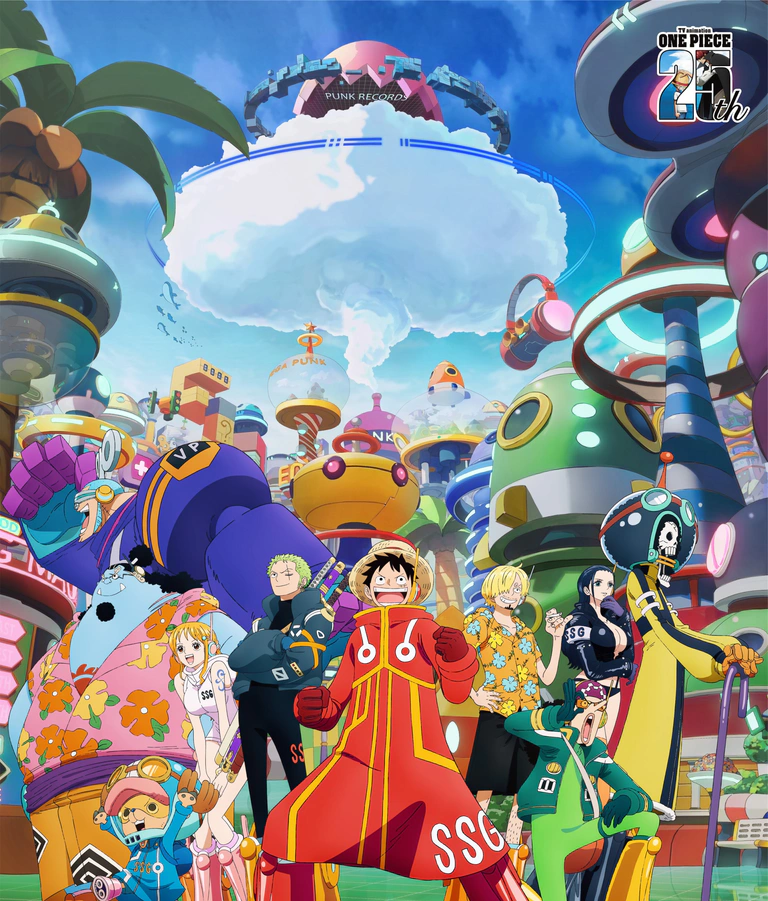
One Piece is an animated series based on the manga of the same name, produced by Toei Animation and broadcasted by Fuji Television. Premiering in October 1999, it has currently aired over 1000 episodes, along with theatrical films and many more TV specials and OVAs, and has been exported to more than thirty nations worldwide.
The series aired episodes on a weekly basis for over 26 years, with no breaks longer than one month until 2020. This release schedule officially ended in 2025 following the conclusion of the Egghead Arc. Starting with the Elbaph Arc on April 5, 2026 the anime will release a maximum of 26 episodes per year in two cours.
One Piece is one of the most popular series in the world, and currently, its anime can be watched on a plethora of streaming sites, including Crunchyroll, Netflix, Prime Video, Hulu (Disney+), Vudu, Pluto, Apple TV, and Sling TV. A second anime adaptation, titled The One Piece, is currently in production by Wit Studio.
Synopsis
Gol D. Roger was known as the Pirate King, the strongest and most infamous pirate to have sailed the Grand Line. The capture and death of Roger by the World Government brought a change throughout the world. His last words before his death revealed the location of the greatest treasure in the world, One Piece. It was this revelation that brought about the Great Pirate Era, men who dreamed of finding One Piece (which promises an unlimited amount of riches and fame), and quite possibly the most coveted of titles for the person who found it, the title of the Pirate King.
Enter Monkey D. Luffy, a 17-year-old boy who questions one's standard definition of a pirate. Rather than the popular persona of a wicked, hardened, toothless pirate who ransacks villages for fun, Luffy’s reason for being a pirate is one of pure wonder; the thought of an exciting adventure and meeting new and intriguing people, along with finding One Piece, are his reasons for becoming a pirate. Following in the footsteps of his childhood hero, Shanks, Luffy and his crew travel across the Grand Line, experiencing crazy adventures, unveiling dark mysteries, and battling strong enemies, all in order to reach One Piece!
Relationship to the Manga
The One Piece anime is—particularly compared to other long-running anime—extensively faithful to its source material, adapting nearly all of the manga's story content with a minimum of deliberate contradiction. Though it has altered and rearranged (and on rarer occasions, removed) a number of the manga's elements, it typically does so for time or content-rating purposes; when such changes contradict material later established by the manga, they are by default ignored, with the manga taking precedence. Due to the long run of the series, there have been recap episodes often told in flashbacks and later with new animation.
(An in-depth listing of the anime's changes may be found on the articles for each individual story arc and—to a lesser extent—the articles for each individual episode.)
Original Content
Toei has produced a considerable amount of original story material—popularly called filler by fans—using the manga's basic setting and characters. These may comprise a single episode or multi-episode arcs; most are written to reconcile with the manga-based continuity, but have no tangible impact on it (and in fact are seldom referenced even by other anime-original material). A complete listing of these arcs and episodes may be found here.
Apart from the standard television anime, Toei has also produced many standalone One Piece works, which fall outside the episode numbering and broadcast schedule. These include:
As a general rule, these standalone works make only loose attempts to fit into any wider continuity, and are always given separate home releases from the "regular" anime (filler or otherwise).
Fifteen theatrical films, traditionally released during Golden Week but given more sporadic releases (as well as more direct contribution from Eiichiro Oda) from the tenth onward.
Three featurettes, bundled respectively with the second, third, and fifth films.
Thirteen television specials, which fall among two subcategories:
Four hour-long specials, all original stories, aired in standard episode timeslots (that coincide with seasonal school breaks).
Nine two-hour specials, a combination of original stories and re-adaptations of manga stories, aired on days preceding standard episodes (also usually coinciding with school breaks).
Various original video animations (OVAs), usually meant to serve as tie-ins for individual films.
Various exhibition shorts, shown exclusively at special events and attractions.
Various recap features, which feature some degree of original content but mostly reuse footage from the television anime.
Censorship
In rare instances, the anime has not adapted certain minor elements of the manga, usually due to their offensive or graphic nature being less suited for broadcast compared to print. Notably, the anime has never shown characters giving the finger, removing Trafalgar Law's instances of it in the Sabaody and Dressrosa Arcs. The anime has also lessened the severity of wounds on occasion; one notable example came in the Marineford Arc where instead of Akainu melting off half of Whitebeard's face, he only melts off part of his mustache.
Story Pacing
The amount of manga material that the anime adapts varies by episode, but further along into the anime's weekly run, the amount adapted per episode has decreased. Every canon arc up to around Thriller Bark had noticeably fewer episodes compared to chapters, with the Arabasta Arc having 39 episodes compared to 63 chapters (an adaptation rate of 1.62 chapters per episode). Since Thriller Bark, which only had three more chapters than episodes, the anime has typically adapted a single chapter or less per episode. Every story arc since Dressrosa has had more anime episodes than manga chapters, with the Wano Country Arc having an adaptation rate of 0.78 chapters per episode.
Adapted content can be stretched into longer timeframes by adding more filler, flashbacks, and/or recaps, as well as by extending existing story beats with techniques like still frames, repeated motion, and reaction shots. To avoid catching up to the manga story, which takes more frequent breaks in serialization, the anime has utilized these padding techniques as well as filler arcs. However, production of filler arcs has decreased significantly since the timeskip. Before the timeskip, 58 total filler arc episodes were produced, in contrast to 18 produced post-timeskip during the weekly anime's run, with no arcs lasting more than four episodes. As a result, post-timeskip episodes have consistently adapted less manga content.
Toei acknowledged the slower pacing of the weekly anime when announcing the changes to its production and release format starting in 2026, saying that the new schedule would allow the anime to match the "tempo and pacing" of the manga.
Distribution
In Japan, One Piece has aired since inception on Fuji Television, one of the nation's oldest and most prominent private networks. Its timeslot has been changed four times throughout its run.
- - 63 - 214 - 278 - 1122 - 1123 - 1124–Present
English Translations
The anime was first picked up for an official English dub by Odex in 2003, which they retained until 2004. It was then licensed for English dub by 4Kids Entertainment in the same year, and the rights were eventually transferred to Funimation Entertainment (now Crunchyroll) after 4Kids dropped their license. Currently, Crunchyroll airs both subbed and dubbed episodes.
4Kids
4Kids Entertainment acquired the rights to broadcast the series in North America on June 8, 2004, airing in the FoxBox block on the Fox network. 4Kids heavily edited the series to make it more appropriate for its target demographic, removing things such as graphic violence, firearms, cigarettes, and reworking some names referencing unsuitable themes such as Ace and Smoker. Some of 4Kids' name changes, most notably changing Zoro to "Zolo", were picked up by VIZ Media's manga translations and continue to this day. 4Kids also skipped some arcs, such as the Reverse Mountain Arc, which would have created plot holes later in the series. Finally, 4Kids created their own opening, the One Piece Theme, which they used throughout their entire run despite critical panning. 4Kids canceled their distribution in 2006, at the end of the filler Ruluka Island Arc.
Funimation
Funimation Entertainment acquired the rights to the anime on April 13, 2007, airing on the Toonami and later Adult Swim block of Cartoon Network despite a cancellation from 2008 to 2013. With a new voice cast, Funimation produced dubbed episodes starting from the beginning. This time, they did not censor the original anime and stuck to a more faithful translation of character names. On November 2, 2013, Funimation began simulcasting English-subbed episodes at the same time as the Japanese broadcast. One Piece returned to Adult Swim's Toonami lineup on May 18, 2013. However, after more than three years, it was announced on March 10, 2017, that One Piece would again be removed from the block after March 18, 2017. One Piece was removed from Toonami after March 18, 2017.
As of December 2020, the subbed version was added to the digital-based Pluto TV and was given its own exclusive channel.
Music
Music has been a constant in the anime since the beginning of its run. Every single episode has begun with an opening theme; to date, there have been 28 openings by 22 different artists. Ending themes have also been used at the beginning and end of the weekly anime's run. 18 endings ran across the first 278 episodes, then were discontinued for 17 years and nearly 800 episodes before returning in Episode 1071, with four more endings running until the anime schedule changed. Background music is commonplace in every episode, and the soundtrack arrangements and songs performed by the character voice actors have been compiled into numerous albums.
Sources
Adapted from the original article, under CC BY-SA 3.0.