Work
One Piece (Manga)
One Piece is a Shonen action-adventure manga written and drawn by Eiichiro Oda…
One Piece is a Shonen action-adventure manga written and drawn by Eiichiro Oda, serialized in the anthology Weekly Shonen Jump. Set in a fantasy world dominated by pirates, it centers on the adventures of Monkey D. Luffy, a headstrong young captain with the power to stretch like rubber.
Premiering in July 1997, One Piece has currently published over 1000 chapters (collected into over 100 tankōbon volumes) and generated a global franchise, including an anime adaptation from Toei Animation, numerous feature films, a live-action series and countless other pieces of merchandise. Since the late 2000s it has been recognized as Japan's most popular manga, even being commemorated by the Guinness World Records as the world's best-selling single-author comic book.
One Piece is divided into two halves: Sea of Survival: Super Rookies Saga, and The Final Sea: The New World Saga.
History
Eiichiro Oda was inspired by Akira Toriyama's Dragon Ball and Dr. Slump at a young age. As a child he was inspired by the animated series Vicky the Viking and wanted to draw a pirate manga series. Later, he created Pandaman for Yudetamago's Kinnikuman. In 1992, at the age of 17, he submitted a one-shot manga called Wanted! to the Tezuka Awards. This got him noticed as a promising mangaka by the staff members of the Weekly Shonen Jump magazine, and he became an assistant under several established manga writers including Shinobu Kaitani, Masaya Tokuhiro and finally Nobuhiro Watsuki.
Oda had interest in making a pirate manga both from his obsession with Vikings as a young man and inspired by various pirate events including the discovery of the pirate ship of Edward Teach (known by his pirate name of "Blackbeard"). He wrote two separate one-shots in the mid-1990s, both of which were called "Romance Dawn". The stories introduced Monkey D. Luffy, a straw-hat wearing boy who set out to sea to become a legendary pirate. Several concepts of the eventual serialization appeared in these stories, including Luffy's inspiration for being a pirate and a mysterious power he gained from eating a special fruit that turned his body into rubber (a prototype for the Devil Fruit).
In August 1997, Oda took many of his "Romance Dawn" ideas and started using them in a weekly serial under the title "One Piece". It was first serialized in Weekly Shonen Jump, the weekly shonen magazine owned by Shueisha. The series quickly caught on and became popular from the initial chapters on, establishing itself as one of the premiere manga series in the magazine.
Originally, Oda wanted his series to run for 5 years (meaning One Piece could have ended in 2002), but he went longer than expected and has no idea how many more years his story will be. However, it should be noted that Oda has stated that the end of Chapter 597 marks the end of the first half of One Piece. Oda has already planned the ending for One Piece. Despite how long it will take him to complete it, he will end One Piece the way he planned from the start.
In June 2022, Oda announced that the manga would enter a one-month break to prepare for its 25th anniversary and its final saga, set to begin with the release of Chapter 1054.
Plot
Gol D. Roger obtained the title of "Pirate King" after obtaining more wealth, fame, and power than any other pirate of his time. He was ultimately executed by the World Government, but proclaimed that he had left his treasure, the One Piece, at "that place" for anyone to find it. This triggered a frenzy of people inspired to raise their own Jolly Roger and set sail, with the general understanding being that the One Piece was on the final island of the Grand Line, Laugh Tale.
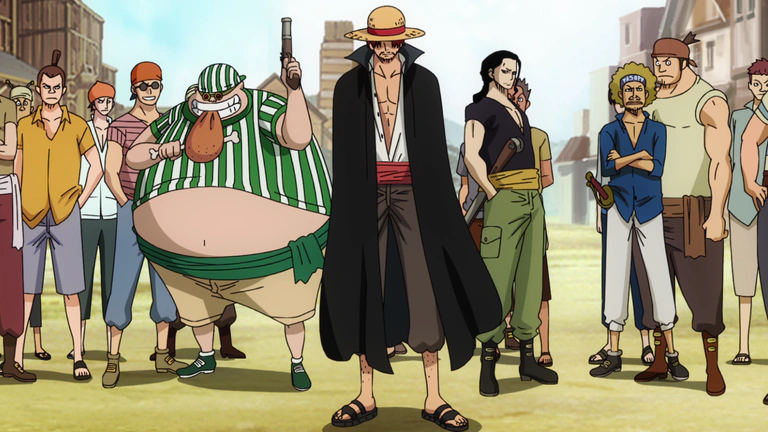
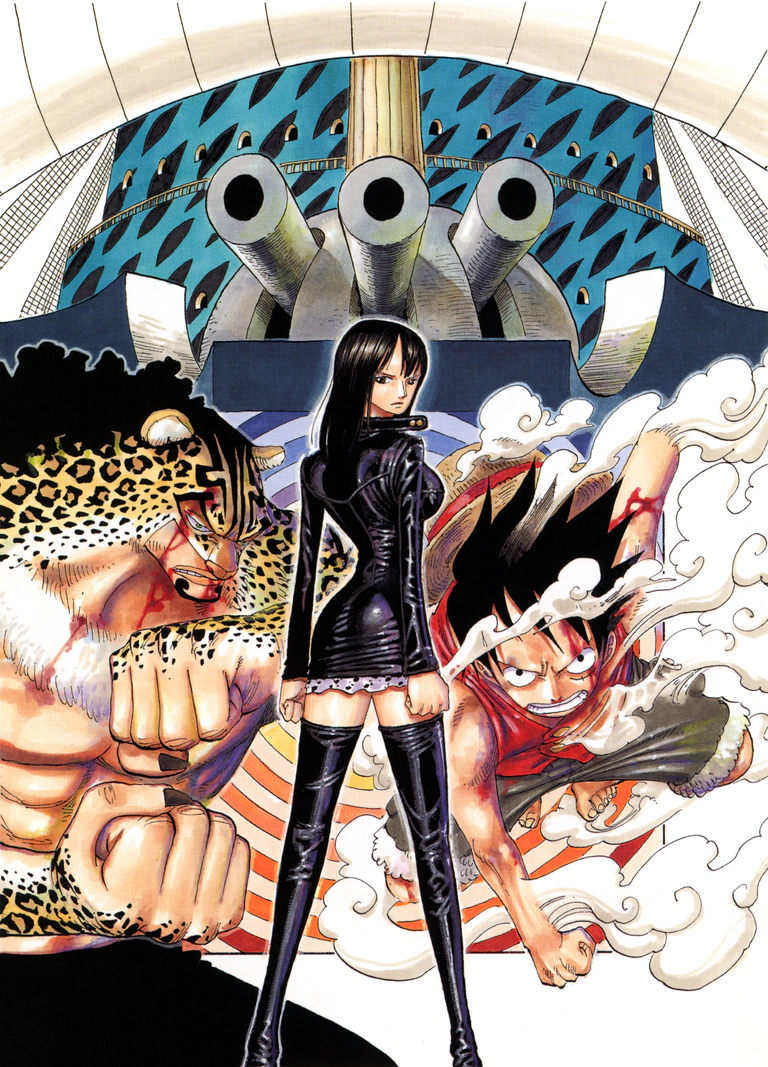
Twelve years later, a young boy named Monkey D. Luffy is inspired by Shanks to pursue his own path to piracy. Shanks gives Luffy his straw hat to wear until he likewise becomes a great pirate. Ten years following this, Luffy sets out to sea. In the East Blue, he recruits four crewmates—swordsman Roronoa Zoro, navigator Nami, sniper Usopp, and cook Sanji—forming the Straw Hat Pirates, and they gain a ship called the Going Merry. The crew enters the Grand Line, but Luffy's actions in the East Blue attract the attention of the Marines, giving him a bounty. In the Grand Line, the Straw Hats get involved in a plot by Crocodile of the Seven Warlords of the Sea to take over the Arabasta Kingdom, and the princess Nefertari Vivi joins their crew until they defeat Crocodile. They recruit doctor Tony Tony Chopper and archaeologist Nico Robin during this time. After adventuring through the sky islands and getting involved in a Davy Back Fight, the Straw Hats invade the World Government stronghold of Enies Lobby to rescue a captured Robin. The Going Merry is destroyed following this attack, and the crew recruits shipwright Franky, who builds a new ship called the Thousand Sunny. The Straw Hats defeat another Warlord, Gecko Moria, and recruit musician Brook. However, the crew is utterly defeated by powerful Marine forces on the Sabaody Archipelago, but are then individually sent to different islands by the Warlord Bartholomew Kuma.
Luffy's sworn brother, Portgas D. Ace, is captured and sentenced to execution by the Marines. Luffy attempts to rescue him and gets involved in the Summit War of Marineford between the Marines and Ace's crew, the Whitebeard Pirates. Despite Luffy's effort, Ace is ultimately killed as well as his captain Whitebeard, though Luffy is able to escape the battlefield. Believing he and his crew are too weak to continue on their journey, Luffy relays a message for the Straw Hats to train for two years on the islands where they were sent.
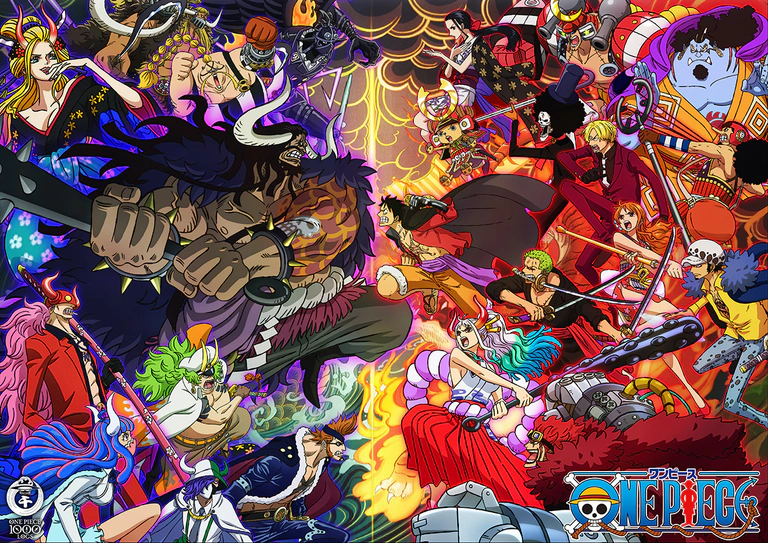
Two years later, the Straw Hats reunite and enter the New World through Fish-Man Island. Shortly after reaching this sea, they form an alliance with fellow pirate Trafalgar Law and samurai from Wano Country aimed at toppling Kaidou of the Four Emperors. The Straw Hats wind up defeating Warlord Donquixote Doflamingo and becoming entangled with another Emperor, Big Mom, in the process, and recruit helmsman and former Warlord Jinbe. Kaidou forms an alliance with Big Mom while the Straw Hats and their allies prepare to attack him in Wano, but despite this the Straw Hats' alliance winds up victorious over both Emperors, and Luffy is named one of the Four Emperors in their stead. In their ensuing voyages to Egghead and Elbaph, the Straw Hats become embroiled in conflict with the highest authorities of the World Government, who are moving to amass military might for a foretold Great War.
Story Elements
Story Arcs: Also called "sagas", which as a term may also be used to encapsulate multiple arcs, these loosely defined episodic plotlines constitute the plot of the manga. The arcs are generally considered to center around the islands the protagonists visit or the individual antagonists they battle, while sagas typically center around a broader region or overarching event or antagonist.
Blue Planet: The main setting of the series; it is covered almost entirely in water with most of its civilizations scattered on many small islands. The highly variable and sometimes fantastical elements of the Blue Planet's geography, and its wealth of varied Animal Species, add a considerable degree of challenge to the voyages of pirates, particularly in the Grand Line where the majority of the series takes place. Has a Moon.
The Blue Planet has two known calendar systems. The year when Luffy sets sail is 1539/4129, while the current year is 1541/4131.
One Piece: The titular treasure which is being pursued by Luffy and the majority of other pirates in the series; though many pirates have differing reasons for searching for it, it is understood that finding the One Piece will grant the mantle of "Pirate King" as well as have a significant impact on the entire world.
Character Groupings
Pirates: Individuals who operate lawlessly at sea, often as part of a crew, typically with the goal of obtaining wealth, fame, power, and sometimes freedom for themselves. The last century has consisted of "eras" defined by the most infamous and powerful pirates to roam the seas at that given time.
Straw Hat Pirates: The main protagonist group of the story, led by the main individual protagonist Monkey D. Luffy. In the initial East Blue Saga, nearly every arc focused on Luffy recruiting a new crewmate. During the crew's adventure through the first half of the Grand Line, each saga saw one or two crewmates join, if any at all. During the ongoing second half entitled the New World Saga, only one new crewmate has joined to this point.
Super Rookies: The most infamous pirates which have recently entered the Grand Line. Luffy and Zoro ranked among them following the Enies Lobby Arc, and the other rookies in their generation have served as allies, rivals, and enemies at various points.
Four Emperors: Four pirates who rule over territory in the New World; they rank as the strongest and most influential pirates in the world and are the largest roadblocks to conquering the Grand Line.
World Government: The largest governing body in the world. Opposed to pirates, and has a long and highly complex relationship with its domain and subjects.
Marines: The primary military arm of the World Government and the most direct threat to pirates. Some Marines are benevolent toward civilians, while others are corrupt, extreme, and/or malevolent.
Seven Warlords of the Sea: A group of privateers receiving legal immunity from the World Government in return for serving its goals and attacking only other pirates. Despite this, several Warlords posed threats to government-affiliated nations.
Cipher Pol: Government agencies which specialize in information gathering, covert missions, and assassination.
World Nobles: The ruling class of the World Government on account of descending from its creators. Bound by no laws and almost always operate according to their desires. The Five Elders constitute their top public authorities, while the Knights of God serve as their top enforcers.
SSG: The World Government's top science unit, which seeks to develop augmented living weapons using cloning to increase the government's military power.
Races: In addition to humans, the Blue Planet is populated by several other humanoid races with diverse physical traits. The relationships between these races, and the ability of non-humans to integrate into global society, drive the plots of several arcs.
Revolutionary Army: A paramilitary force which directly opposes the World Government. Has rapidly risen in strength and infamy in the past decade.
Underworld: A secret network where illegal trade is conducted outside the oversight of the World Government's enforcement arms. Controlled by kingpins known as Emperors.
Concepts
Dreams: The future aspirations of characters serve as a primary driving force for the actions of involved parties, including both the protagonists as well as the antagonistic forces they encounter. Each Straw Hat member has a well-defined dream which provides much of the impetus for their characterization. It has been repeatedly indicated and even demonstrated that sufficient willpower can potentially go as far as to alter the natural order of the world.
History: The events that occurred in the past, stretching back nearly a millennium, play a large role in the present-day story. Many arcs center around how the actions and desires of past people and groups affect the current state of the world, and how their goals have been inherited by their descendants or adherents.
Void Century: The period of time between 800 and 900 years ago when the World Government was founded. For unclear reasons, the World Government has destroyed nearly all records of this time and criminalized research into its events. The only surviving records are those etched in special stones known as Poneglyphs. Those who manage to reach the final island of the Grand Line will become aware of the events of the Void Century in the process.
Great War: A history-defining conflict which originated in the Void Century and figures to be revived in the present day, with the fate of the world understood to be at stake.
Will of D.: A mysterious concept linking people scattered across the world who all bear the middle initial "D." in their names, which includes Luffy. Although even these people do not know what the initial means in the present day, the world has slowly become more aware of its significance in the course of global events.
Mythology: There exist several mythical and legendary figures in the world whose traits are manifested in present day individuals (often through Devil Fruits). Those who bear the forms and powers of these deities are anticipated to shape the course of history according to how these legends describe, although societies may not know for sure how these figures will manifest and what they will specifically do.
Powers and Abilities
Devil Fruits: A series of special fruits, each of which grant a unique supernatural ability or bodily state. The price for eating one is the loss of ability to swim in water, posing a dilemma for pirates. However, most pirates, especially the most powerful, have consumed one regardless.
Haki: A supernatural sensory and bodily enhancement power set manifested from a person's willpower. Two types can be awakened by anyone, while the third and most powerful type is only accessible to those born with the "qualities of a king". Haki is rare in most of the world, save for the second half of the Grand Line where it is very common.
Six Powers: A set of superhuman martial arts techniques; predominantly trained and utilized by World Government forces.
Ancient Weapons: Three weapons dating back to the Void Century which possess the ability to destroy the world if used. Have been dormant since this time, but still exist in various forms and whose usage will define the course of the Great War.
Voice of All Things: Concerns the ability to "hear" the true speech of certain animals and objects. Very few people in the world possess the capability to hear this "Voice".
Style
At the time of its release, the dot-eyed style of artwork seen in anime like Dragon Ball was becoming less popular and manga and anime seemed to be moving over for the more popular big-eyes style of drawing, made famous by series like Sailor Moon. Eiichiro Oda was fully aware of the change of art style and was worried early on in its run that his style would put off people from reading his manga. As time progressed and One Piece's popularity grew, Oda was able to relax the style more, resulting in One Piece's drawing style becoming much looser and more kinetic. During One Piece's early run, the characters had a somewhat more cartoonish and roundish design.
As well as its unusual art style, the style of weird drawn characters had been another worry of Oda. Another problem at the time of early production was that the Bishie was becoming a popular form of manga character depiction and "ugly" or "weird" manga characters were becoming significantly harder to sell. However, these character designs have since become one of One Piece's selling points, allowing more eccentric characters to be drawn.
Themes
Many real-world items were the primary focus on certain characters, storylines, and arcs.
Censorship - Primarily the focus of the Ohara storyline in the Enies Lobby Arc, including Nico Robin.
Classism - A common theme throughout the series with the World Nobles, the Vinsmoke Family, nobles of the Goa Kingdom, and their very poor attitudes and behavior toward those of lower status being prime examples, and one of the focuses of the Wano Country Arc where low-class citizens in Wano Country are discriminated, restricting them to live in slums and wastelands like the extremely poor Okobore Town where they are only allowed to consume leftovers.
Corruption - A common theme throughout the series with the World Government itself as prime example being through its really dubious, questionable policies and actions, and a focus in the Wano Country Arc where despite being against the law in Wano to make contacts with outsiders including pirates, the nation's shogun Kurozumi Orochi is allied with Kaidou, one of the Four Emperors, and his crew, the Beasts Pirates.
Drug Addiction - Portrayed in the form of children having been tragically fed with addictive drugs, the victims' behavior shows how dangerous a substance like this can be. Also portrayed in the Fish-Man Island Arc, with Hody Jones and his crew, the New Fish-Man Pirates.
Eugenics - Ace, Luffy, and Robin were targets for discrimination due to their parents, Mont Blanc Cricket due to his ancestor, and Rebecca due to her family. Another example is the fact that the World Nobles act superior to others due to their heritage.
Genocide - Ohara was an island in the West Blue whose entire population was eradicated (aside from Robin) on the orders of the Five Elders. A Buster Call was declared on the island in order to end the perceived threat posed by the archaeologists and historians of Ohara, for the crime of studying and pursuing the truth behind the Void Century. To make certain that none of the "Demons of Ohara" could survive, people who had no affiliation to the scholars were killed as well. In the North Blue, the island of Flevance also had its people exterminated to prevent the spread of Amber Lead Syndrome (despite the World Government having knowledge that the disease was non-contagious and only affected the island's inhabitants). As was the case in Ohara, the entire population (aside from Trafalgar Law and Flevance royalty) were killed to end this perceived threat.
Isolationism - One of the focuses of the Wano Country Arc where Wano Country prohibits contact with outsiders and borders are a crime. The late daimyo of Kuri Kouzuki Oden dreamed of opening his country to the outside world.
Justice - Seen throughout the series, but primarily focused on during the Water 7 Arc, Enies Lobby Arc, and Summit War Saga.
Pursuing One's Dreams - Focused on throughout the series, particularly with the Straw Hat Pirates, however the Jaya Arc in particular brought this most in the open.
Racism and Xenophobia - During the Arlong Park Arc, the conflict between the fish-men and humans was a subject of the story line, this later was expanded as newer tribes and cultures were introduced in the series with the main focus being the Sabaody Archipelago Arc and the Fish-Man Island Arc.
Slavery - A common theme throughout the series with the Arlong Park Arc, Sabaody Archipelago Arc and most recently the Wano Country Arc are all known examples of slavery.
Status Divide - It is focused on with the Straw Hat Pirates' status as pirates, the World Government's status as "world leaders", the Marines' status as "protectors of the world", the Revolutionary Army's status as "rebels and criminals" and the World Nobles as well as nobles thinking they have a higher status than everyone else.
Oppression - A common theme throughout the series with the World Government like its use of Absolute Justice, abuse of power by its World Nobles, and weapons and inventions designed or blueprinted by Dr. Vegapunk to help enforce its control as main examples. It's also one of the focuses in the Arlong Park Arc, Dressrosa Arc and Wano Country Arc.
Pollution - One of the focuses in the Wano Country Arc, Kaidou's factories across the Wano Country that taints the condition of air and rivers.
Poverty - One of the focuses in the Wano Country Arc, citizens who live outside the Flower Capital struggle to support themselves and their families financially. Other prime examples that are revealed during the Egghead Arc being countries affiliated with the World Government are full of the poor and civilians forced to collect bounties of Marines placed by Cross Guild to help feed their starving families at the cost of being hunted by said Marines, but receives invitation to join Cross Guild to gain protection and support for them and their loved ones.
Propaganda - One of the focuses in the Wano Country Arc where schools taught at the Flower Capital indoctrinate its students into believing the Kouzuki Family and their retainers to be the villains, and Orochi, Kaidou and the Beasts Pirates to be the heroes of Wano, reinforcing Orochi and Kaidou's reign and policies.
War - Focused on during the Arabasta Saga, Skypiea Arc, Summit War Saga, Wano Country Arc, and most recently the Final Saga.
War profiteering - The Warlord of the Sea Donquixote Doflamingo taking advantage of the instability he caused for nearby peaceful nations after usurping King Riku, profiting from the weapons he provides them during their wars. His subordinate, Caesar Clown also provides weapons of mass destruction to warring nations.
Mythology
The real-world mythology seems to have played a great role in inspiring Oda to create One Piece. The same can be said for various other well-known stories, books, and other known myths:
Enel was a self-proclaimed god with the power of lightning.
The Kuja Pirates, consisting of females exclusively, seem to have many similarities with the Greek Amazons.
The Kuja Pirates' Jolly Roger features a skull with snakes replacing hair, which is a reference to the Greek myth of Medusa, the woman who had snakes instead of hair and who was able to petrify anyone who looked into her eyes. This is also displayed by Boa Hancock's Devil Fruit power, which allows her to turn people to stone.
The names of the Marine admirals (Aokiji, Akainu, and Kizaru) are known to have been taken out of a Japanese folklore, Momotaro. The three animals that followed Momotaro on his quest were the dog (inu), monkey (saru) and pheasant (kiji).
The Thriller Bark Arc may have been inspired by Tim Burton's Nightmare Before Christmas, Frankenstein, and Michael Jackson's song that has the same name: "Thriller".
The Fish-Man Island Arc has several references to fairy tales, notably the Japanese legend of Urashima Taro, and the legend of the Little Mermaid.
The Punk Hazard Arc has mythological creatures such as dragons, centaurs, satyrs, yetis, and harpies (most of these creatures are related to Greek or Roman myths).
Theology
Despite some theologic aspects through out the series, real-world theology is referenced via the several naming patterns:
Sodom and Gomorrah, the two pets of the Franky Family, were named after the two cities mentioned in the Bible as places where people sacrificed their children, contributed to men having intercourse with other men, and oppressed the poor. These two cities were destroyed by Yehovah God.
The Treasure Tree Adam, Sunlight Tree Eve, Tree of Knowledge are named after elements in the story of Book of Genesis.
King Neptune is named after the Roman god of the sea.
Pandora, Prometheus, Zeus, and Hera are named after figures from the Greek mythology.
The names of the Five Elders and three Ancient Weapons are named after the planets of the solar system, with the separation reflecting the five known planets (with the exception of earth) at the time of the heliocentric model discovery, which was initially heavily rejected by the catholic church.
The name of the Ancient Weapons are also references to figures from Greek mythology.
Editors
One Piece has had several editors throughout its serialization. The editors work closely with Oda, acting as his supervisors and giving him input on the story. All editors have been informed by Oda on how the series will end.
Since 2008, there are have been two editor positions: manga editor and media editor. The media editor supervises other aspects of the One Piece media franchise, such as the anime. Typically, an editor starts as the manga editor and then moves to the media editor position before retiring from One Piece. Currently, there are three media editors, who are also in charge of running the official Twitter account @Eiichiro_Staff and the Instagram account @onepiece_staff.
Generation Name Manga Editor Term Media Editor Term Notes - 0 Kushima Unknown – 1996 – - 1 Takanori Asada "Daasa" 1996 – May 2001 – - 2 Takahiro Habuta "Habuyan" May 2001 – February 2005 June 2020 – Present - 3 Daisuke Watanabe February 2005 – October 2006 – - 4 Naoki Kawashima "Pooh-san" October 2006 – November 2007 – - 5 Kohei Onishi November 2007 – June 2008 June 2008 – December 2010; February 2013 – June 2014 - 6 Akira Jean-Baptiste Hattori "Bapti" June 2008 – December 2010 December 2010 – February 2013 - 7 Takeru Isaka December 2010 – June 2014 June 2014 – January 2017 - 8 Sugiru Sugita "Osugi" June 2014 – January 2017 January 2017 – 2019 - 9 Takuma Naito "Naikin" January 2017 – March 2019 March 2019 – Present - 10 Ken Takano "Takanogym" March 2019 – June 2020 June 2020 – Present - 11 Yuuji Iwasaki "Amazaki FC" June 2020 – February 2023 – - 12 Kaito Anayama February 2023 – January 2025 – - 13 Junya Fukuda January 2025 – Present –
Editor for Oda's one-shots up until the release of Romance Dawn, Version 1.
Manga editor from the Romance Dawn Arc to the Arabasta Arc.
Manga editor from the Arabasta Arc to the Water 7 Arc.
Manga editor from the Water 7 Arc to the Enies Lobby Arc.
Manga editor from the Enies Lobby Arc to the Thriller Bark Arc.
Manga editor from the Thriller Bark Arc to the Sabaody Archipelago Arc.
Manga editor from the Sabaody Archipelago Arc to the Fish-Man Island Arc.
Manga editor from the Fish-Man Island Arc to the Dressrosa Arc.
Manga editor from the Dressrosa Arc to the Whole Cake Island Arc.
Manga editor from the Whole Cake Island Arc to the Wano Country Arc.
Manga editor during the Wano Country Arc.
Manga editor from the Wano Country Arc to the Egghead Arc.
Manga editor from the Egghead Arc to the Elbaph Arc.
Manga editor during the Elbaph Arc.
English Translations
As One Piece began growing in popularity, it received English translations as it became more popular in the West.
VIZ Media is the first and sole provider of officially translated One Piece manga material. It began publishing translated chapters in its Shonen Jump magazine in November 2002 and publishing translated volumes in June 2003. While not censoring as many details as their anime counterpart 4Kids Entertainment did, VIZ has used some 4Kids names earlier on, the most famous of those being changing Roronoa Zoro's name to Zolo, a practice they still continue in order to maintain continuity.
Since 2019, the first three and latest three chapters of One Piece have been available to read for free on the VIZ official website and on Shueisha's Manga Plus website. The rest of the manga can be accessed with a monthly subscription.
Related pages
Chapters and Volumes
Colorwalks and Color Spreads
SBS
Popularity Polls
One Piece Omake
Name Variants
One Piece Databooks
Sources
Adapted from the original article, under CC BY-SA 3.0.